The Week Ahead – August 31-September 6

iAbout Press releases
As part of our continuing efforts to bring you as much information about our region as possible we offer readers a press release service that allows private firms, public agencies, non-governmental organisations and other groups to submit relevant press releases on our website.
All press releases in this section are published in their full length and have not been edited.
If you have a press release or other announcement you would like to have published, please send it to [email protected].
We reserve the right to reject press releases we deem irrelevant or inappropriate.
All material submitted to The Arctic Journal, including pictures and videos, will be assumed to be available for publication by The Arctic Journal and its related entities.
Each Monday, we give a brief run-down of some of the events and issues affecting the Arctic we’ll be paying attention to in the coming week. If you have an event you think should be included next week, please contact us.
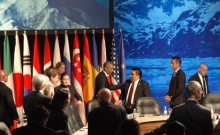
For a discussion of today’s GLACIER conference, please refer to the Week Ahead for August 24-30, and to these stories on our website:
- No-one said this would be easy
- Water, water everywhere, but not a drop to flush
Yesterday’s party?
Open a Faroese news website today, and chances are you’ll get a pop-up advert, informing you that “Tomorrow, it’s time vote.”
The adverts are run by Sambandsflokkin, the party of Kaj Leo Johannesen, the incumbent premier. Polls, however, suggest that when voters cast their ballots tomorrow, his time will be up.
Mr Johannesen, who whose centre-left party has ruled since 2011 in a coalition with Folkaflokkin, a pro-independence party, was forced to call the election after uncertainty about his role in the construction of a tunnel that may have mis-used public funds.
As with any political discussion in the Faroe Islands, fisheries have been a major issue, particularly in light of the fact that a fisheries reform must be passed by 2018. The final details have yet to be worked out, however, and until they are, new initiatives in the industry, which is the country’s largest, have been put on hold.
Working in Mr Johannesen’s favour is the fact that the Faroese economy is doing well. This is in part due to the fact that it has not joined the EU sanctions against Russia and its fish products, particularly salmon, have replaced Norwegian products there.
Such is the strength of the Faroese economy that its annual subsidy from Copenhagen, amounting to 644 million kroner ($97 million), makes up just 5% of its GDP. Greenland, by contrast, receives 3.6 billion kroner annually, an amount equal to half its GDP. With less economic dependence on Copenhagen, and an often awkward relationship with the Danes, not least when it comes to the EU, one of the topics has also been whether the time is ripe for the island’s to secede from the Kingdom of Denmark entirely.
This economic robustness, and thus the arguments for the country going it on its own, may be further strengthened if the country’s oil exploration bears fruit.
Such funding may be required, however, if pledges to reinvigorate the healthcare system are to be fulfilled. The Faroe Islands spends less of its GDP on healthcare than other Nordic countries, and with an ageing population, medical professionals are warning that a funding gap is emerging.
That more socially oriented topics, such as same-sex marriage and whether the Faroe Islands should accept asylum seekers, have been big issues underscores that the country is on generally good footing. Mr Johannesen’s proposal that the country house 60 refugee families has not been popular with voters, however, and that may, despite all the good news, turn Sambandsflokkin into yesterday’s party.
Nuka, queen of the Eskimos
Can one be cool, Inuit and gay all at the same time? That is the question Eskimo Diva, a new documentary, will seek to explore when it opens in Danish cinemas on September 10. The first reviewer screenings of the film, which was recorded in Greenland, are scheduled for this week. Their write-ups, accompanied by trailers (below) and awkward photographs (above), will make certain that a discussion of the subject of homsexuality in Greenland takes hold well before audiences find their seats. “This is a story about a young man who fronts an exciting revolution,” the film’s promotional material states. Enquiring minds will want to know whether Greenlanders are ready for a revolution that is led by a queen.
Trailer, in Danish with English subtitles.
Waiting for NSIDC
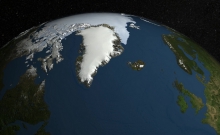
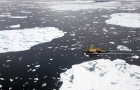
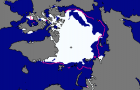
The monthly sea-ice report from NSIDC, a US research outfit, are likely due out this week. Sea-ice levels will continue to decline in September, but the August figures will be watched as an indicator of this year’s minimum extent. The July sea-ice extent was 9.5% below the 1981-2010 average and the eighth lowest since 1979, when satellite measurements first began. The 2015 minimum extent is unlikely to set a record, but NSIDC figures show that the rate of decline accelerated between June and July, and that the pace in August was faster than average. Meanwhile, according to Noaa, a US science agency, June and July both set records as the warmest months ever recorded. It also predicts 2015 could be the warmest year on record.