Arctic’s ship still over horizon
iAbout Press releases
As part of our continuing efforts to bring you as much information about our region as possible we offer readers a press release service that allows private firms, public agencies, non-governmental organisations and other groups to submit relevant press releases on our website.
All press releases in this section are published in their full length and have not been edited.
If you have a press release or other announcement you would like to have published, please send it to [email protected].
We reserve the right to reject press releases we deem irrelevant or inappropriate.
All material submitted to The Arctic Journal, including pictures and videos, will be assumed to be available for publication by The Arctic Journal and its related entities.
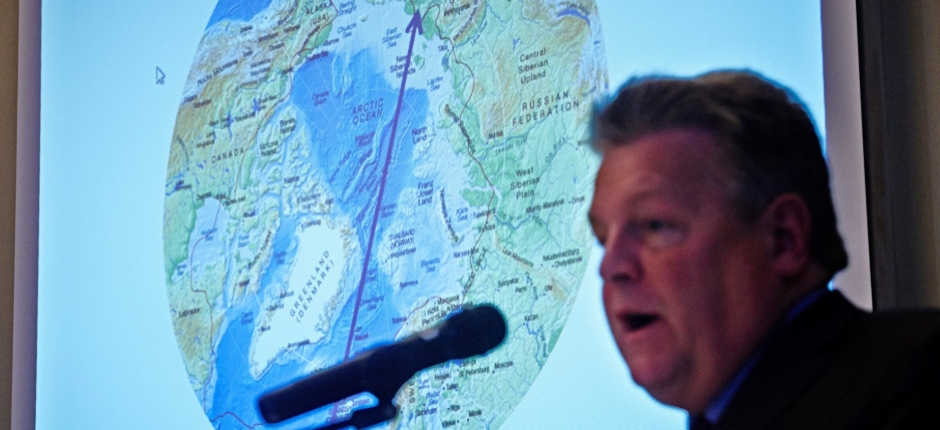
Decision-makers interested in the increasing feasibility of Arctic shipping routes gathered in Copenhagen for the first annual meeting of the Arctic Policy and Economic Forum last week were told that there is room for optimism, but also a need for patience.
Arctic shipping lanes as shortcuts for traditional routes through the Panama and Suez canals have become increasingly promising in recent years, but their viability as a competitive alternative remains at least a decade over the horizon, according to many within the inudstry.
Nevertheless Dr Damien Degeorges, the founder of the Arctic Policy and Economic Forum, which organised the conference, said that with attendees from as far away as Australia, the event showed shipping had become a “major topic”.
“The Arctic is no longer a periphery of the globe but a central area where global powers meet,” he said.
There are two paths you can go by
Development in the Arctic is often categorised as taking one of two paths – oil and minerals extraction or shipping – but Degeorges said in the case of Greenland, which could see a number of mines open in the coming years, the two were intertwined.
Greenland’s primary international port is Aalborg, Denmark, and Degeorges pointed out that gave it a strong link to the European market.
Even though cargo volumes are only expected to reach 21 million tons in 2021, compared with 930 million tonnes passing through the Suez Canal in 2011, the number of ships successfully completing the route grew to 270 last year, up from just two in 2009.
SEE RELATED: Shippers: plenty of potential in Arctic sea route
For countries on the western edge of the Arctic, the growth has been hard to ignore, and some have already moved to establish themselves as the primary hub for receiving trans-arctic vessels.
In Iceland and Finland efforts are already underway to establish those countries as a transfer point for cargo heading to Europe and North America from Asia. Other countries may soon follow suit.
Slow speed ahead
The growing interest in the Arctic, however, should not overshadow the problems sailing in the region still poses, warn some.
Writing in Canada’s Globe and Mail about the opening of the Canadian Arctic to shipping traffic, John Higginbotham, of Carleton University, recognised its potential, but also pointed out that it lacked infrastructure, search and rescue capabilities and navigational aids to support growth.
“It will be years before the [Northwest Passage] is truly ‘open for business’,” he wrote.