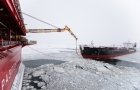
Amid the the allure of the Northwest Passage, tragedy lurks

iAbout Press releases
As part of our continuing efforts to bring you as much information about our region as possible we offer readers a press release service that allows private firms, public agencies, non-governmental organisations and other groups to submit relevant press releases on our website.
All press releases in this section are published in their full length and have not been edited.
If you have a press release or other announcement you would like to have published, please send it to [email protected].
We reserve the right to reject press releases we deem irrelevant or inappropriate.
All material submitted to The Arctic Journal, including pictures and videos, will be assumed to be available for publication by The Arctic Journal and its related entities.
As polar ice melting makes more shipping possible in the Northwest Passage, the shortcut between Europe and Asia that links the Atlantic and Pacific oceans north of the Arctic Circle is being touted by many as a major shipping route of the future.
Take the case of the Danish-flagged vessel Nordic Orion. Hauling 73,500 tonnes of coal, it shaved 1,000 nautical miles and six days off the trip from Vancouver to Finland earlier this month, saving $200,000 in tolls and fuel costs, according to the ship’s owners by sailling through the Northwest Passage.
The recent rush to get ships through the Northwest Passage is anything but a new idea. It has been sought for centuries as a viable trade route. Irish naval officer Robert McClure is credited with discovering the link and first completing the route, by ship and sled, in the 19th century.
The lost expedition
The most ill-fated trip through the passage is by far the most famous. British explorer Sir John Franklin and 128 members of his expedition died after their ships, the Erebus and the Terror, became trapped in ice while trying to complete the passage.
Franklin’s lost expedition departed England in 1845. A Royal Navy officer and experienced explorer, Franklin had served on three previous Arctic expeditions, the latter two as commanding officer. His fourth, and last, was meant to cover the last unexplored section of the Northwest Passage.
Over the next 150 years, explorers, and scientists would try to piece together what happened. Franklin’s men wintered in 1845–46 on Beechey Island, where three crew members died and were buried. The ships became trapped in ice off King William Island in September 1846 and never sailed again.
According to a note dated April 25, 1848, Franklin had died on June 11 the year before; the crew wintered on King William Island in 1846–47 and 1847–48, and the remaining crew planned to begin walking on April 26, 1848 toward Back River, on the Canadian mainland. Nine officers and fifteen men had already died. The rest would die along the way.
A tragic end
In 1981, a team of scientists began a series of studies of the graves, bodies and other physical evidence left by Franklin crew members. The combined evidence suggested that hypothermia, starvation, lead poisoning and disease including scurvy, along with exposure to a hostile environment whilst lacking adequate clothing and nutrition, killed everyone on the expedition.
The Victorian media portrayed Franklin as a hero despite the expedition’s failure and the reports of cannibalism. The lost expedition has been the subject of many artistic works, including songs, short stories, novels, and television documentaries.
No matter who discovered the Northwest Passage, Canada maintains it has historic rights over the route as its ships escort foreign vessels and its military enforces laws in the waterways adjacent to Canadian lands. Canada’s claims are disputed by other countries, including the US, who argue the Northwest Passage is an international seaway.
The route has a strong place in Canadian lore, and was commemorated in the song in the video below by the late Canadian folk singer Stan Rogers.