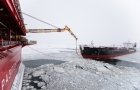
Container ship’s journey highlights prospect, challenges of Arctic routes

iAbout Press releases
As part of our continuing efforts to bring you as much information about our region as possible we offer readers a press release service that allows private firms, public agencies, non-governmental organisations and other groups to submit relevant press releases on our website.
All press releases in this section are published in their full length and have not been edited.
If you have a press release or other announcement you would like to have published, please send it to [email protected].
We reserve the right to reject press releases we deem irrelevant or inappropriate.
All material submitted to The Arctic Journal, including pictures and videos, will be assumed to be available for publication by The Arctic Journal and its related entities.
In China, they call the new northern sea routes the “Arctic golden waterway". Professor Bin Yang of Shanghai Maritime University estimates the routes could save China $60 billion to $120 billion per year.
On August 8, the Yongsheng, a 19,000-tonne container ship, sailed from the port of Dalian in northeast China to Rotterdam on a test run through what is known as the Arctic Northwest Passage.
The ship should reach the port of Rotterdam on September 11. The trip through the Bering Strait will be faster than sailing the traditional Suez Canal route.
Due north
Other Asian trading nations are also looking north. Shipyards in South Korea, Singapore and India are building cargo ships and tankers with hulls capable of withstanding ice.
The routes are being eyed as alternatives to the Suez Canal, which is controlled by politically unstable Egypt and requires sailing the pirate-infested Arabian Sea.
On the other side of the globe, the Panama Canal is controlled by Panama, which often takes its cues from the US. The passage is also too narrow for many large vessels.
Ships can currently only avoid these problematic spots by sailing around Africa or South America. The extra distance costs time, fuel and wages.
The northern routes could become alternatives; the Bering Strait is a deep, wide, pirate-free channel between Russia and Alaska connecting the Pacific and Arctic Oceans.
To the east, Canada’s Northwest Passage offers a 7,000 kilometre shortcut to the US Atlantic Seaboard. To the west, Russia’s Northern Sea Route offers a 10,000 kilometre shortcut to Europe.
Stormy seas
Some shipping experts say that the jury is still out on the northern routes taking the place of their southern counterparts. There are no guarantees that the passages now being made possible by climate change will remain ice free.
Although the route being taken by the Yong Cheng is shorter and safer than the Suez, commercial shippers say that it will only be viable in the summer and then only if the ice stays away.
Changing ice levels make it hard for companies that plan portage sometimes years in advance to rely on the Arctic routes.
“The big fear is that you get there and cannot cross because an area is blocked and then you decide to go back to take the Panama route”, commented Simon Bennett, an executive with the International Chamber of Shipping, in October 2007.
Sovereignty issues may slow the parade of international ships heading through northern waters. The US insists that the passages are international straits which may be used without constraints, while Canada and Russia claim them as internal waters requiring permission to enter.
Although no serious incidents have resulted from the dispute, the uncertainty could make commercial shippers reluctant to take the chance.