
Bringing the mountain to the negotiators
iAbout Press releases
As part of our continuing efforts to bring you as much information about our region as possible we offer readers a press release service that allows private firms, public agencies, non-governmental organisations and other groups to submit relevant press releases on our website.
All press releases in this section are published in their full length and have not been edited.
If you have a press release or other announcement you would like to have published, please send it to [email protected].
We reserve the right to reject press releases we deem irrelevant or inappropriate.
All material submitted to The Arctic Journal, including pictures and videos, will be assumed to be available for publication by The Arctic Journal and its related entities.
In order to save the ice, it must, at least in part, be melted. This is perhaps the thinking behind a planned exhibition of Greenlandic ice this December, during the annual UN climate conference.
Some 50,000 delegates are expected to attend the summit, taking place this year in Paris. Among them will be world leaders, including Barack Obama, seeking to work out an agreement to prevent the climate from further warming.
By displaying tonnes of melting ice Olafur Eliasson, an Icelandic-Danish artist, and Minik Rosing, a Greenlandic geologist, hope to remind the negotiators of the effects that the warming climate is having.
SEE RELATED: Ice, art and being human
Mr Eliasson has explained that by now, most people are aware of climate change. The point of the displays, he says, is to allow people to experience it.
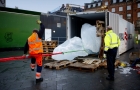
Displaying massive hunks of ice in this way is dramatic, though not unique. And the Paris display will itself be a repeat of the pair’s work in October 2014 in Copenhagen, during another UN climate meeting. The display, titled Ice Watch, involved 12 chunks of ice, weighing a total of 100 tonnes, arranged into the form of a clock.
The Paris display will be bigger, but what sets the works apart from standard ice sculptures is that they will be taking ice from Greenland.
Ensuring that it gets there as the large chunks the Paris display will require, and not crushed bits, takes more than just refrigerated containers, says Kuupik Kliest, a former Greenlandic premier who now heads Group Greenland, a consultancy.
SEE RELATED: Ice, ice, erverywhere
One consideration, Mr Kliest says, is that glacial ice tends to shatter when taken out of seawater. To avoid that, the ice will be pulled by tugboat to port, where a 40-foot shipping container, with its sides removed, will be lowered into the water, and chunks of ice trimmed to fit inside.
Getting it out in a useable state poses a second challenge. If the ice inside the container is suddenly exposed to higher temperatures, it can crack. This can be avoided, Mr Kleist says, by gradually raising the temperature inside the container during transport.
Keeping the world’s ice intact will, hopefully, involve an entirely different strategy.




Most read
