The Arctic theatre
iAbout Press releases
As part of our continuing efforts to bring you as much information about our region as possible we offer readers a press release service that allows private firms, public agencies, non-governmental organisations and other groups to submit relevant press releases on our website.
All press releases in this section are published in their full length and have not been edited.
If you have a press release or other announcement you would like to have published, please send it to [email protected].
We reserve the right to reject press releases we deem irrelevant or inappropriate.
All material submitted to The Arctic Journal, including pictures and videos, will be assumed to be available for publication by The Arctic Journal and its related entities.
Barack Obama arrives in Alaska on Monday for what will be his first official visit to the state and to the modern Arctic.
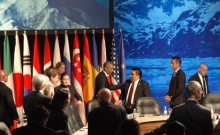
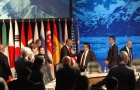
Here, Mr Obama will participate in GLACIER, an event hosted by John Kerry, the secretary of state, and attended by foreign ministers from most Arctic countries and from other countries with an interest in the region.
In preparation for the visit, the White House, on August 15, released a short video (at end of article) in which the president makes it clear that his administration views Alaska and the Arctic first and foremost as the epicentre of climate change.
SEE RELATED: The polar bear in the room
This focus is significantly different from the emphasis prevalent in other Arctic countries, including Russia, which sees the region more as a potential source of unfathomable amounts of oil, gas and minerals. Oil and gas are also on the mind of decision-makers in Oslo, who are also focused on fisheries and the challenging relationship with neighbouring Moscow. For the Danes, the Arctic poses the additional challenge of an increasingly autonomous Greenland.
For Mr Obama, the Arctic is now a front in a much larger political campaign. As he indicates in the video, his Alaskan visit is part of a carefully designed strategy to make climate one of the main issues in the Democratic effort to retain the White House in the 2016 general election and to make Hillary Clinton his successor. Mr Obama, for example, describes not only how Alaskans are badly affected by rising temperatures, but how “most Americans” are already witnessing the effects of climate change in the form of prolonged droughts, extreme wildfires and flooding. The people of Alaska may well be on the “front line” of these changes, as he says, but it is the American people collectively who Mr Obama now strives to identify as victims of climate change.
The president’s effort to make the climate a key issue with American voters began earlier this month, when he unveiled ambitious plans to limit the use of coal in the US, but such is the scope of his climate campaign that it also already encompasses America’s chairmanship of the Arctic Council.
As such, US domestic politics and the president’s desire to throw his weight behind global efforts to curb climate change will have an impact on the other seven Arctic countries. After a Canadian chairmanship that focused on non-traditional areas such as economics and human development in Arctic communities, Washington is now pushing the Arctic Council back on a course that is more directly focused on climate change. Diplomats have noted that the Obama administration is using the Arctic Council as part of an effort to reach average Americans as stresses the immediacy of climate issues.
SEE RELATED: Washington’s folly
The concern in other Arctic countries is that this could lead to other topics being put on the back burner. Health and social issues in the far-flung North are two that risk losing attention. Other previously high-profile issues that may see less focus include search and rescue and protection of the marine environment. Work on these efforts will continue, of course (‘marine stewardship’ is, in fact, one of the focus areas of America’s chairmanship), but it may well be climate matters that take precedence.
GLACIER (a backronym for Conference on Global Leadership in the Arctic: Cooperation, Innovation, Engagement and Resilience) is an example of this. The meeting is not an Arctic Council event, and no specific agreements are expected to come out of the meeting. Nevertheless, most Arctic Council states are expected to send their foreign ministers, not least because of the sheen Mr Obama’s presence casts over the gathering. (In Denmark, many will recall how Lene Espersen, a former foreign minister, stayed home from an Arctic Five attended by Ms Clinton, then America’s secretary of state. The gaffe cost Ms Espersen months of hard criticism and eventually the leadership of her party.)
Climate and communicating with the American public now dominate the administration’s Arctic agenda, but this will not necessarily lead to a lack of attention to the plight of many Arctic residents. On the contrary, it may be beneficial in two ways. Prior to the 2009 UN climate conference in Copenhagen, it became de rigeur for world leaders to travel to Ilulissat to see ‘first hand’ the effect global warming was having on the climate. For the people of the Arctic, this meant serving as the poster children for the harmful effects of climate change; this may not be the image they prefer, but it does direct attention to their needs.
Mr Obama, in his video, describes melting glaciers and Alaskans whose lives are drastically altered because of the changes in the climate. Some have seen their homes destroyed because the permafrost they stood on thawed.
SEE RELATED: A risk they can’t refuse
The president promises to meet with people affected by climate change and with representatives from other countries to discuss what can be done.
“The alarm bells are ringing,” Mr Obama says. “As long as I am president, America will lead this world to meet this threat, before it is too late.”
Although climate is not the only topic on the agenda during GLACIER, it seems certainly the most important for the organisers, and it will be an element of most discussions that are held there. This may also help Mr Obama better his own chances prior to global climate negotiations at the UN climate summit in Paris in December. If he can display in Alaska that the US is serious about preventing further climate change in the Arctic, where it is having a much greater impact than elsewhere, his arguments may seems more credible in Paris.
Conservation groups have railed over the apparent hypocrisy of, on the one hand, Mr Obama’s efforts to appear concerned about climate change in the Arctic, while, on the other, permitting Shell to explore for oil in the Chukchi Sea. Others will ask why he has suddenly become aware of the problems faced by Alaska’s indigenous groups only now, when it suits his political needs.
The author is a Danish journalist who has written extensively about Arctic issues, including most recently The Greenland Dilemma.