Showing the way
iAbout Press releases
As part of our continuing efforts to bring you as much information about our region as possible we offer readers a press release service that allows private firms, public agencies, non-governmental organisations and other groups to submit relevant press releases on our website.
All press releases in this section are published in their full length and have not been edited.
If you have a press release or other announcement you would like to have published, please send it to [email protected].
We reserve the right to reject press releases we deem irrelevant or inappropriate.
All material submitted to The Arctic Journal, including pictures and videos, will be assumed to be available for publication by The Arctic Journal and its related entities.
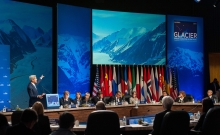
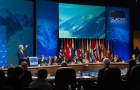
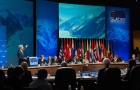
(Anchorage) With his 25-minute speech to the GLACIER summit here on Monday, Barack Obama appeared to signal a new era in America’s involvement in international efforts to address climate change.
“I’ve come here today, as the leader of the world’s largest economy and its second largest emitter, to say that the United States recognises our role in creating this problem, and we embrace our responsibility to help solve it,” Mr Obama said, adding, to the glee of the audience, that the world’s remaining climate sceptics, were “on their own shrinking island”.
The president, in his address, drew upon the full weight of his office as he underscored the seriousness of the damage that climate change, if unchecked, can cause.
“We will condemn our children to a planet beyond their capacity to repair: Submerged countries. Abandoned cities. Fields no longer growing. Indigenous peoples who can’t carry out traditions that stretch back millennia. … Desperate refugees seeking the sanctuary of nations not their own. Political disruptions that could trigger multiple conflicts around the globe.”
VIDEO: President Obama and Secretary of State Kerry address GLACIER (at end of article)
In a joint statement issued at the end of the meeting, all of the other Arctic states, together with a group of observer-states from the Arctic Council, among them China, Japan, France and South Korea, declared themselves in full agreement with the president’s message. They also supported his administration’s desire for an “ambitious” global agreement during the UN climate summit in Paris in December.
Mr Obama’s address is, first and foremost, being hailed as a sign that America is now serious about climate change. For those hoping that a new agreement can be reached in Paris, it provides new hope for the deal that did not emerge during the 2009 UN climate meeting in Copenhagen, which was the last time leaders from the major powers gathered to reach such an agreement.
Others, however, also note that how the president is also emphasising the role of the US in the Arctic and the significance of the Arctic in global affairs much stronger than it has in the past. Mr Obama explained how his administration regards developments in the Arctic as closely linked to developments in the rest of the world. In the past, the Arctic has often been constructed as a series of independent, regional issues (think polar bears, Russian oil or Greenlandic uranium). By choosing an Arctic setting for a pivotal speech of global reach and through his clear message, Mr Obama illustrates how his administration now tends to consider the Arctic part of the global political mainstream.
GLACIER was not an Arctic Council event. It was was a strictly American initiative, but few seemed to notice that difference. That America is using its Arctic Council chairmanship, which it took over from Canada in April, in this manner marks something of a departure. In the past, chairs have often chosen to focus on regional issues, like search and rescue, biodiversity, oil response and healthcare. Mr Obama, in contrast, is using his Arctic platform to send messages of a distinctly global nature, even as he announces new federal programmes to assist climate victims in Alaska.
SEE RELATED: Editor’s Briefing | Power to the council
The administration repeatedly underscores that the changes in the Arctic brought about by warming temperatures are part of the larger global discussion and negotiations about climate change. For Mr Obama, the effects being experienced by Arctic communities are just a taste of what people in other parts of America and throughout the world can expect: powerful storms, coastal erosion, flooding, droughts and forest fires. The simple fact that Mr Obama and John Kerry, his secretary of state, organised an Arctic conference to address global climate issues, as well as regional climate concerns and then did it on such short notice, serves as a clear indication of the importance they now attach to the region.
The effect this will have remains to be seen. Arctic communities hope the new attention will bring with it more money to move their homes and to otherwise mitigate the impacts of climate change. For Arctic states, it will require a re-evaluation of their position. GLACIER gathered nearly all the states with an interest in the Arctic, and thus illustrated for the first time that the Arctic Council members and its observer states, together, have powerful global reach. It also showed that America is capable of utilising this potential quickly and effectively.
This forces the other Arctic states to consider how to continue to address regional issues and, while at the same time facing a reality in which they are junior partners to an administration that appears ready to use the Arctic also to promote key domestic priorities. Mr. Obama’s climate initiative includes more than just securing an agreement in Paris this December and assisting troubled Arctic villages. By making climate a major issue, he hopes also to help Hillary Clinton, a fellow Democrat, in her campaign to win the 2016 general election.
SEE RELATED: Critics bemoan Ottawa’s lost Arctic Council opportunity
America’s new approach could also challenge the long-standing custom amongst Arctic states that major policy moves and decisions are made in full agreement with indigenous groups. This dogma appeared to have been watered down somewhat during GLACIER. The indigenous peoples of Alaska were certainly visible and often heard during the event, but Danish diplomats, for example, had to push in order to secure a member of Naalakkersuisut, Greenland’s elected government, a seat among the state representatives. At Arctic Council meetings, indigenous groups hold a de facto veto power. In Anchorage, they seemed not to enjoy this kind of status.
Such differences may seem academic, but GLACIER showed just how much weight Washington can throw behind an initiative, and just how quickly the American public, media, think tanks, federal agencies and academic institutions are to respond to signals from the White House. The lesson that others have learned previously, and which the Arctic is now waking up to, is that Washington’s influence is such that whenever America sets a priority, it changes the discussion and influences the options available to its allies.
Prior to GLACIER, America’s coast guard, for example, staged exercises in Alaskan waters. Onshore, meanwhile, academics and other professionals gathered to discuss topics ranging from Arctic research to maritime capabilities in the region. Journalists, too, had been well primed, leading for instance The New York Times, an influential news outlet, to publish a front-page article the day before the gathering about America’s challenges in the Arctic.
SEE RELATED: At the end of a long and winding road, a look back
TV stations, too, have devoted much airtime to a region that generally receives little coverage. During the conference, we were privileged to hear senior officials from various federal departments, research institutes, the Coast Guard and environmental agencies present their Arctic priorities. Mostly they were in lock-step with Mr Obama, and their efforts will facilitate the his effort to land an international climate agreement and to woo the American public.
Before, during and after GLACIER, the White House tweeted, posted updates to Facebook and put videos on YouTube, all in an effort to drive home Mr Obama’s message to the American public. During the meeting itself, a couple of hundred of foreign journalists were on hand to push the message abroad. The ministers and diplomats there to represent their countries cannot have missed the administration’s main message.
With its pivot to the North, Washington is pulling the Arctic into the realm of global politics, accelerating a process that has been underway for some time, not least through the admission of new Arctic Council observers from Asia. This process brought the world to the Arctic. At GLACIER, we saw how the Arctic is now coming to the world under US guidance.
The author is a Danish journalist who has written extensively about Arctic issues, including most recently The Greenland Dilemma.