High risk, low price
iAbout Press releases
As part of our continuing efforts to bring you as much information about our region as possible we offer readers a press release service that allows private firms, public agencies, non-governmental organisations and other groups to submit relevant press releases on our website.
All press releases in this section are published in their full length and have not been edited.
If you have a press release or other announcement you would like to have published, please send it to [email protected].
We reserve the right to reject press releases we deem irrelevant or inappropriate.
All material submitted to The Arctic Journal, including pictures and videos, will be assumed to be available for publication by The Arctic Journal and its related entities.
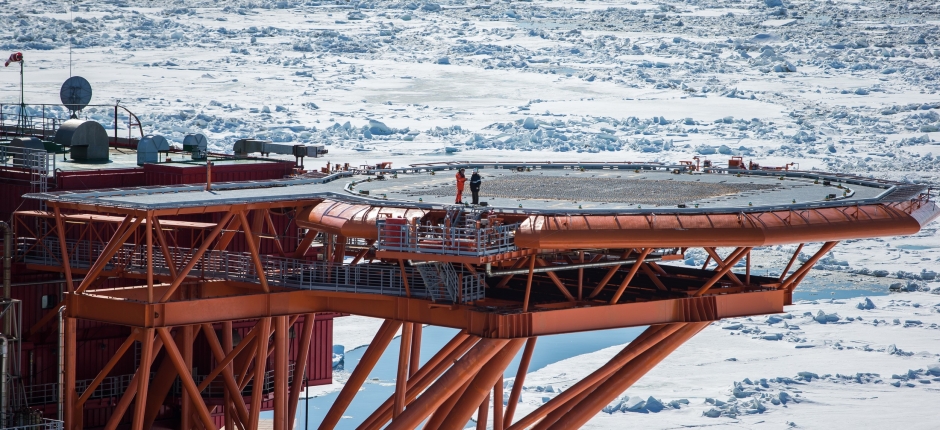
“The Leiv Eriksson is perhaps the most controversial oil rig anywhere on the planet.” That was the assessment made in 2011 by Ben Ayliffe, a Greenpeace activist, after he had boarded the rig to protest exploration in Greenlandic waters.
Four years later, it is another Arctic drilling rig, the Polar Pioneer, leased by Shell for its Alaska offshore programme, that is causing controversy. This time, though, the trouble is coming from two directions.
Like the Leiv Eriksson, the Polar Pioneer is a red cloth for environmentalists, who warn that the vast distances, cold water temperatures and short working season all make cleaning up a spill in the Arctic considerably more complicated than spills in temperate waters.
SEE RELATED: Tough oil, easy decision
But unlike 2011, the price of oil this year is struggling to remain above $50 a barrel. Four years ago, a barrel of Brent Crude, an industry benchmark, averaged $111.
The current fall in prices, which began last summer, is a concern for oil firms: this year, industry-wide cost-cuts will total $180 billion, or 20% of 2014 spending. Another $200 billion in major projects, including deep-sea drilling, tar sands and a number of Arctic projects, have been delayed.
The combination of high risk, low price and falling investment has, according to Rystad Energy, an analysis firm, raised concerns in the industry of whether Arctic oil and gas resources will ever be produced.
“Rystad Energy does not expect many significant Arctic exploration campaigns in the short and medium term,” the firm wrote in March.
SEE RELATED: Pride and petroleum
So why, despite the environmental and financial controversy associated with Arctic drilling, is Shell pressing on in Alaska?
One reason is an expected rally in demand. Company executives have expressed publicly that they foresee a long-term price rebound as global demand rises. Analysts, too, suggest that by 2020 prices could again be around $100 a barrel. The estimated production price of Arctic oil is between $40 and $100 a barrel.
In the short-term, there may already be evidence of an initial rise in demand: the August figures released by the International Energy Agency, an energy watchdog, show the strongest demand for oil in five years.
Improving demand, however, is no sign of the quick turn-around. The excess supplies, brought about by over-investment, that have forced prices down will dry up, but only gradually, the IEA predicts.
SEE RELATED: Editor’s Briefing | Victory in the Arctic
Still, rising demand and falling supply will help to elevate the price, perhaps to around $70 per barrel by 2017. That will allow more leeway for the expensive development projects that have had to be put on hold.
Higher prices or not, producers must find ways to replace fields as they run dry. Currently, Shell’s fields are declining at an estimated rate of 5% annually, amounting to about five million barrels a day by 2030.
Identifying where those new fields are cannot be delayed. Traditional oil fields typically take 12 years to reach production. Hard-to-reach deposits in the Arctic could need over two decades to go from discovery to production, Rystad reckons.
Another reason for Shell’s tenacity may be the $6 billion it has already invested in the Arctic. Much of that went to the purchase of its Alaska licences in 2008.
The expectation at that time was that low prices had become a thing of the past. Now that prices seem set to rebound, a decision not to drill would be a controversial one as well.