Russia’s new blend
iAbout Press releases
As part of our continuing efforts to bring you as much information about our region as possible we offer readers a press release service that allows private firms, public agencies, non-governmental organisations and other groups to submit relevant press releases on our website.
All press releases in this section are published in their full length and have not been edited.
If you have a press release or other announcement you would like to have published, please send it to [email protected].
We reserve the right to reject press releases we deem irrelevant or inappropriate.
All material submitted to The Arctic Journal, including pictures and videos, will be assumed to be available for publication by The Arctic Journal and its related entities.
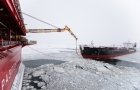
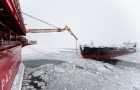
Vladimir Putin, Russia’s president, was characteristically bullish last month when he announced that the first oil from the Prirazlomnaya platorm, in the Arctic ocean, was now flowing into the ice-breaking tanker Mikhail Ulyanov, and would soon be headed to market.
“The start of loading the oil produced at Prirazlomnaya means that the entire project will exert a most encouraging influence on Russia’s presence on the energy markets and will stimulate the Russian economy in general and its energy sector in particular,” he said.
In a statement of how important Arctic oil is for Russia, Putin was on hand to witness the first shipment, some 70,000 tonnes of oil, which was loaded onto a tanker from the Prirazlomnaya platform – the same platform that Greenpeace activists unsuccessfully tried to scale last year.
Putin and other backers of Arctic oil have just as much about its economic impact as Greenpeace and other activists have fretted about the environmental damage getting it out can cause.
Little, though, has been said about Russia’s economic calculus. Perhaps that is because on paper Arctic oil drilling looks like a gold mine. To start with, the region holds an estimated 30 percent of the world’s remaining undiscovered oil and gas resources. Add to that receding Arctic ice, Russia’s vast Arctic territory and its experience drilling oil elsewhere and the country would appear to be in a strong position to capitalise on whatever underground resources might be there.
That is where the good news ends for Moscow. For all Russia’s crowing about the economic impact its energy operations will bring, there is little to suggest that cost of extracting it can be recouped any time soon.
The Prirazlomnoye field, where the oil is coming from, holds an estimated 530 million barrels of oil. While that is a significant amount, nearly 84 percent of the reserves are located offshore, in an area beset by darkness for half the year and ice – even with rising temperatures – still posing a year round threat.
Ironically, what drives up the price of Arctic oil are some of the same factors that worry environmentalists: ice, severe weather and a lack of infrastructure.
But even before the oil could be taken from the ground, Gazprom needed to establish operations, a process that required the construction of both a so-called ice-proof drilling rig, as well as two ice-breaking tankers specially designed to off-load the oil.
Similar projects in the Russian Arctic have been put off due to high costs, and were it not for Russian government support in the form of tax breaks, sources said the Prirazlomnoye field would not have come online.
Despite all the effort and cost that has gone into getting the oil flowing (not to mention the bad PR) the field’s contributions to Russia’s energy output will be minimal; Gazprom forecasts that when the field is fully operational in 2020 it will account for less than 1 percent of the country’s oil production.
Russia, however, might be taking a long-term perspective on its Arctic oil. Production in its established fields are on the decline and it needs to find new reserves if it hopes to keep output up.
SEE RELATED: Gazprom confirms new Arctic drills
While the oil, designated ARCO (Arctic Oil), costs a king’s ransom to get out of the ground, Gazprom is forced to sell it at something of a discount, since it is of a lower quality than oil pumped elsewhere, including in the Russian Urals.
“The cost of a barrel of oil on the platform itself is $40,” said Mikhail Krutikh, a partner with RosEnergy, a consulting firm, told TV Rain, an independent Russian TV station, in a recent interview. “But transporting it in small tankers is very expensive and geometrically raised the price of the oil. If the price of oil per barrel falls to $80 or $90, the project will not be profitable at all.”
The small ships Krutikh referred to are the Mikhail Ulyanov and its sister ship, the Kirill Lavrov. Because they are specially built to sail in the Arctic, they can carry less than traditional tankers.
Given the high cost, low price nature of Arctic oil, experts, including Nicholas Cunningham, of Oilprice.com, suggest there might be an other variable Russia is taking into account: the growing rivalry between Russia and its Arctic neighbours.
“While the Ukraine crisis may be currently driving events in the Arctic, both Russia and the West fear losing out to the other in the far north, despite what appears to be a small prize.”