The years of changing rapidly
iAbout Press releases
As part of our continuing efforts to bring you as much information about our region as possible we offer readers a press release service that allows private firms, public agencies, non-governmental organisations and other groups to submit relevant press releases on our website.
All press releases in this section are published in their full length and have not been edited.
If you have a press release or other announcement you would like to have published, please send it to [email protected].
We reserve the right to reject press releases we deem irrelevant or inappropriate.
All material submitted to The Arctic Journal, including pictures and videos, will be assumed to be available for publication by The Arctic Journal and its related entities.
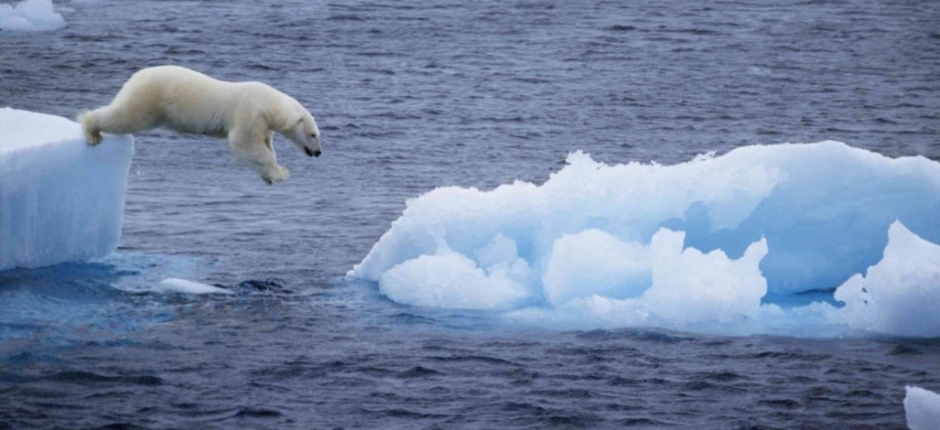
While the general decline in the health of Arctic ice, both at sea and on land, has been well-documented, there is still much discussion about the pace at which the changes are happening and what effect they might have. New research made public in recent days will stoke the debate.
The first of a pair of papers documenting rapid changes used data collected by CryoSat-2, a European satellite, between 2010 and 2014, to determine how sea ice reacted to changes in the length of the summer melting season.
While the data confirmed the consistent decline in sea-ice levels (noting a 14% loss between 2010 and 2012) seen numerous times before, the findings, published in Nature Geoscience, concluded that sudden rebounds were possible.
SEE RELATED: Warm, dark and worrisome
The finding is based on data from 2013, when temperatures were 5% below the previous year. The result was an ice level 41% higher than the previous melting season.
The reason, says Rachel Tilling, a PhD candidate at University College London and the lead author, was because the colder temperatures (which were similar to those seen in the 1990s) prevented ice north-west of Greenland from melting, as it had in previous years.
The authors underscored that this did not indicate an overall rebound in sea-ice levels. Indeed, they point out that despite staving off the first so-called ice-free summer by a few years, at best, temperatures remain on an upward trend, making the event an inevitability. In the end, they reckon that their data will likely prove most useful in refining predictions of when sea ice can be expected to break up entirely.
Nevertheless, Ms Tilling suggests that the data indicate that even slightly cooler temperatures could cut the melting season short and allow for a significant annual recovery to be made.
SEE RELATED: Annual Arctic report card: G for green
The authors credited CryoSat-2 with making the findings possible by improving sea-ice research in two ways. Firstly, by making it possible observe ice at the regional level. Secondly, the new technology allows scientists to peer under the ice, “where most of the action happens”, Ms Tilling says.
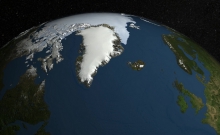
The second paper, which is awaiting peer review before being published in Atmospheric Chemistry and Physics, takes a look at the impact melting ice – this time in the form of the Greenlandic and Antarctic ice caps – could have on sea level.
Predictions of sea-level rise, even catastrophic rise, as a result of melting ice caps are not new. What is different about the findings are the speed with which they are predicted to occur, and that they could occur even if global warming targets are met.
By the standards of the first paper, the time scale is significantly longer, nevertheless the authors note that the effects – a sea-level rise of more than three metres within 50 to 100 years – are ‘rapid’ on a climactic scale.
SEE RELATED: Melting above their weight
The findings are based on changes that occurred 120,000 years ago, during the most recent inter-glacial period (or the period between two ice ages). During that period, known as the Eemian, ice-melt led the to rise up to nine metres and caused extreme storms, the study found. All this occurred during a time when temperatures were less than 1°C warmer than they are today.
The temperature is difference important. Climate scientists have long reassured us that we could avoid the worst effects of global warming if we can limit temperature increases to 2°C above pre-industrial temperatures.
The authors beg to differ. Global warming, they say, is currently less than 1°C, yet climate change is occurring much faster than available models predict. Their explanation is that the effect of amplifying feedbacks, changes caused by global warming that add to the pace of change, is greater than previously understood.
Should their predictions turn out to be correct, then meeting the 2°C goal would turn out to be too much, too late.