
Editor’s Briefing | Not f’d yet
iAbout Press releases
As part of our continuing efforts to bring you as much information about our region as possible we offer readers a press release service that allows private firms, public agencies, non-governmental organisations and other groups to submit relevant press releases on our website.
All press releases in this section are published in their full length and have not been edited.
If you have a press release or other announcement you would like to have published, please send it to [email protected].
We reserve the right to reject press releases we deem irrelevant or inappropriate.
All material submitted to The Arctic Journal, including pictures and videos, will be assumed to be available for publication by The Arctic Journal and its related entities.
It was with uncharacteristic clarity for an academic that Jason Box explained what would happen if methane trapped beneath the soil and seabed of the Arctic were to be released.
We’d be “f’d” (as in fucked), Box, a respected climatologist with GEUS, the Danish and Greenlandic geological survey, tweeted in June.
If scientists in recent years have spoken in increasingly urgent terms about the need to address global warming, then Box’s tweet (which in full read: “If even a small fraction of Arctic sea floor carbon is released to the atmosphere, we’re f’d.”) took the conversation to the next level.
If even a small fraction of Arctic sea floor carbon is released to the atmosphere, we're f'd.
— Jason Box (@climate_ice) July 29, 2014
(He later told Motherboard, a technology news website, that he stood by the tweet, but that if he sent it again he would have added ‘surface carbon’, i.e. the stuff that’s locked up in permafrost.)
Were Box just a foul-mouthed undergraduate, it would be easy to write off his tweet as a sophomoric rant. But with two-decades of experience in the Arctic, Box knows his sh!t when it comes to the effect of rising temperatures in the region.
SEE RELATED: Methane report ignites renewed climate fears
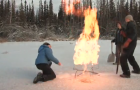
That much methane is trapped under the Arctic is no secret. (In fact, lighting fire to escaping methane bubbles from ponds and lakes (see photo above) is something of a pastime for folks living in certain parts of the world.)
Likewise, methane’s potential to wreak havoc on the climate has long been understood by scientists. Part of the concern about methane is that it is 20 times as potent as carbon dioxide. More worrisome, though, is that 40% of it is trapped underground, and most of that in areas where the temperature is rising rapidly. (The other 60% comes from human activity like farming and industry.)
We would like underground methane to remain where it is, but the warming temperatures risk changing that. On land, as permafrost thaws (not melts) it could release methane as organic matter starts breaking down.
At sea, as water warms, clusters of methane trapped in ice due to high pressure and low temperature start to percolate to the surface. Underscoring just how serious scientists feel this is, SWERUS-C3, an international Arctic research mission that took place this summer, made measuring greenhouse emssions from the Arctic Ocean one of its main goals. The initial results were that methane levels were indeed elevated.
SEE RELATED: From dark to worse
On land, scientists have measured this process happening throughout the Arctic, particularly in Siberia. (Remember that sinkhole in Yamal this summer?) The same was expected to be happening in Alaska, where scientists with Noaa, a federal science agency, have measured steady increases over the past three decades.
It was with some relief, then, that Nasa, America’s space agency, announced this week that its most recent data from Alaska, obtained in 2012, did not show increased levels of atmospheric methane.
That is good news, since it means the methane is staying put. For now.
For, as Charles Miller, a Nasa scientist involved with the study, pointed out, “The 2012 data don’t preclude accelerated change in the future.”
In other words, we could still be f’d.
KEY READS
- NASA: Alaska Shows No Signs of Rising Arctic Methane
Jet Propulsion Laboratory - Observing and investigating
SWERUS-C3 - "Vast methane plumes escaping from the seafloor" discovered in Siberian Arctic Sea
Daily Kos - Mysterious Siberian crater attributed to methane
Nature - If We Release a Small Fraction of Arctic Carbon, 'We're Fucked': Climatologist
Motherboard - Seven facts you need to know about the Arctic methane timebomb
The Guardian
About Editor’s Briefing
Editor’s Briefing is a daily overview of a single current issue or an individual country. The briefing itself provides a summary of the main points about the day’s topic, while the included list of key reads gives readers a place to begin if they would like to learn more. Other internet bits and bobs, including Tweets and videos are occasionally added. As a way to encourage discussion about the topic, the briefing will also seek to include opinionated commentary. If you would like to suggest a topic for a briefing, or if you would like to provide a comment about a topic, please contact us.





Most read
