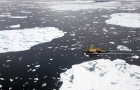
Two is the lowest number

iAbout Press releases
As part of our continuing efforts to bring you as much information about our region as possible we offer readers a press release service that allows private firms, public agencies, non-governmental organisations and other groups to submit relevant press releases on our website.
All press releases in this section are published in their full length and have not been edited.
If you have a press release or other announcement you would like to have published, please send it to [email protected].
We reserve the right to reject press releases we deem irrelevant or inappropriate.
All material submitted to The Arctic Journal, including pictures and videos, will be assumed to be available for publication by The Arctic Journal and its related entities.
Next week Barack Obama will be meeting in Alaska with high-level officials of countries that have an interest in the Arctic. The meeting and the attention being given to America’s role as chair of the Arctic Council are two signs that they want to increase the profile of US interests in the region.
One thing Mr Obama will not be able to brag about during the get-together is his country’s operating capacity in the region. While other countries, most notably Russia, have embarked on ambitious plans to build icebreakers, America operates just two. Russia, according to a 2013 count, has 37, with four on order and eight more planned, including the world's most powerful.
Comparisons are difficult given that Russia has a vastly longer Arctic coastline, and significant economic interests in the region. Still, other Arctic states, and even some non-Arctic states, are increasing their spending on icebreakers.
SEE VIDEO: On duty with the Healy (at end of article)
The US Arctic ice-breaking flotilla is owned and operated by the Coast Guard. It consists of the Healy, a medium-duty ship commissioned in 1999, and the Polar Star, a heavy icebreaker that went into service in 1976. The Polar Sea, its sister ship, has been out of service since 2010 because of serious engine problems.
Lawmakers are in the process of deciding whether to scrap or repair the Polar Sea. Even though inactive, its upkeep still amounts to $8 million a year. It would cost $100 million to repair it and approximately $650 million to maintain and run it over ten years of operational life it is estimated to have left.
The two active ships spend much of the year undergoing maintenance, and at any given time the US only operates one icebreaker. The Coast Guard maintains in a business case presented to Congress that its two icebreakers are enough to cover its responsibilities in the areas of resupply, research and search and rescue. A second heavy icebreaker would provide needed redundancy, but “would come at the expense of more pressing and immediate operational demands”.
Though current resources meet demands, lawmakers in Washington acknowledge that a plan needs to be in place to replace the ageing icebreakers. It is generally agreed on that a new icebreaker will run $1 billion to build. No-one agrees on where that sum (which is about the same amount as the Coast Guard’s annual budget) should come from.
SEE RELATED: Editor’s Briefing | Icebreakers
Don Young, an Alaska congressman, is hoping to use Mr Obama’s visit to bring attention to the matter. In a letter to Mr Obama, dated August 19, Mr Young and two other congressmen encourage the White House to widen the options under consideration for funding to include the departments of defence, commerce and transport, rather than expecting that the funding can come from entirely from the Coast Guard’s budget. The congressmen also suggest that contracting out ice-breaking responsibilities to a private firm could be a feasible option.
All these considerations are laid out in the National Icebreaker Fund Act, introduced into Congress on July 30. If the legislation is voted into law, a fund would be built up over several years to pay for construction of a new icebreaker. Normal government procedure is to grant funding on a year-to-year basis, but such thinking all but rules out the Coast Guard setting aside money on its own. A spokesperson for Mr Young, who is a sponsor of the bill, says the next step is consideration by a Congressional committee, which Mr Young hopes will takes place in the coming months.
David N Biette, of the Wilson Center, a Washington, DC-based think tank, gives the proposal little chance of passing. “The bill will fail,” he says.
SEE RELATED: Beat your bombs into icebreakers
Ultimately, he reckons, funds will be found to refurbish the Polar Sea, but it will come at the last minute. Congress, in general, is loath to spend money unnecessarily, and for most lawmakers, a heavy icebreaker has little bearing on their chances of re-election. “Finland gets it because the whole country gets cold. It’s hard to make the case, say, in South Carolina.”
Mr Biette maintains that while US ice-breaking capacity is “woefully thin” the country is still a serious player in the Arctic because of its well-equipped Air Force and its participation in scientific missions that use other countries’ icebreakers.
Mr. Young, however, warns against complacency. “The United States can ill afford to stand by while other Arctic nations assert themselves,” he wrote to Mr Obama.
Moving forward, may require not just brute force, but also technique.