For Alaskans, Arctic politics is local politics
iAbout Press releases
As part of our continuing efforts to bring you as much information about our region as possible we offer readers a press release service that allows private firms, public agencies, non-governmental organisations and other groups to submit relevant press releases on our website.
All press releases in this section are published in their full length and have not been edited.
If you have a press release or other announcement you would like to have published, please send it to [email protected].
We reserve the right to reject press releases we deem irrelevant or inappropriate.
All material submitted to The Arctic Journal, including pictures and videos, will be assumed to be available for publication by The Arctic Journal and its related entities.
Alaskans gathered in Seattle for the second day of the Arctic Encounter Symposium on Saturday ratcheted up their criticism of Washington for what they see as Washington’s failure to include people in the state in key decisions affecting them.
On Friday, the gathering’s first day, people preferred to sidestep directly criticising the past week’s White House orders closing off parts of the state to oil drilling. That changed on Saturday, when dissatisfaction with federal government on issues ranging from resource policy to a lack of ice-breaking capacity bubbled to the surface.
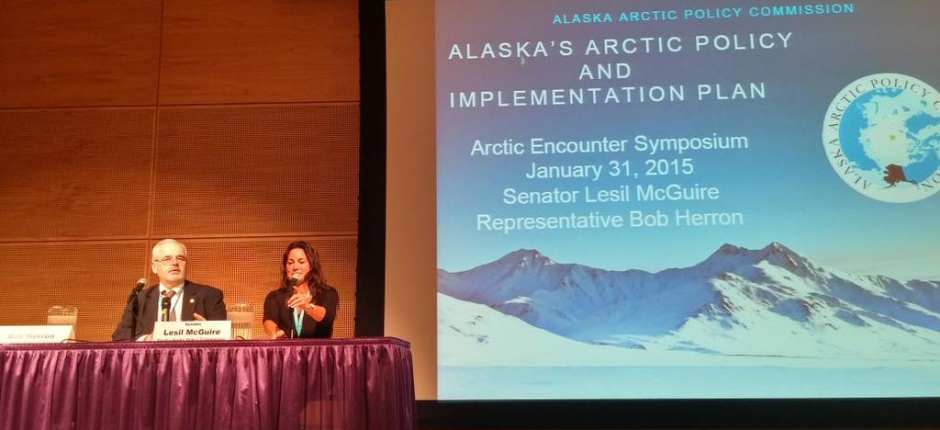
“We don’t want to see policies from other parts of the government that bind our hands,” said Lesil McGuire, a long-time state senator, as she laid out the details of a report expected to form the foundation of the state’s own Arctic policy.
McGuire, together with Bob Herron, another state legislator, are the co-chairs of the Alaska Arctic Policy Commission, the organisation that presented the report to the state legislature on Friday. They noted that they had gone to lengths to include input from Alaskan residents, which they said stood in contrast to the way Washington went about creating policies that affected the state.
“Alaska,” McGuire said, “does good governance by listening.”
Craig Fleener, who was recently named by Bill Walker, Alaska’s governor, as the state’s senior advisor for Arctic policy, re-iterated that America is an Arctic power thanks to Alaska, one of the common themes here this weekend. Nevertheless, he noted that decisions being made outside the state often affected its people negatively.
In addition to calling for more Alaskan involvement in the decision-making process, he urged people outside Alaska to consider issues like drilling from an economic as well as an environmental perspective.
“There must be a balance,” he said. “We cannot say ‘drill it all’ or ‘save it all’.”
SEE RELATED: Now, more than ever
One of the most vocal critics of Washington’s recent policies towards the state has been Lisa Murkowski, who represents Alaska in the Senate. Murkowski responded to the White House orders last week by suggesting that they were an “unprecedented assault” on the state’s sovereignty.
She admitted yesterday that the comments had been provocative, but added that they came in response to what she found to be “deeply troubling” decisions that would limit the state’s ability to develop its economy.
“If our opportunity to provide increased revenue is limited, then what are we going to do?” Murkowski said.
Edward Itta, a highly respected Alaska Native leader who has wowed audiences this weekend with his down-to-earth descriptions of the mixed blessing of development, said he had yet to take a position on the recent White House announcements, but that they lacked native input made them a failure in his eyes.
“It disappointed me to have to hear presidential edicts that affect my life on CNN.”