Inuit I am
iAbout Press releases
As part of our continuing efforts to bring you as much information about our region as possible we offer readers a press release service that allows private firms, public agencies, non-governmental organisations and other groups to submit relevant press releases on our website.
All press releases in this section are published in their full length and have not been edited.
If you have a press release or other announcement you would like to have published, please send it to [email protected].
We reserve the right to reject press releases we deem irrelevant or inappropriate.
All material submitted to The Arctic Journal, including pictures and videos, will be assumed to be available for publication by The Arctic Journal and its related entities.
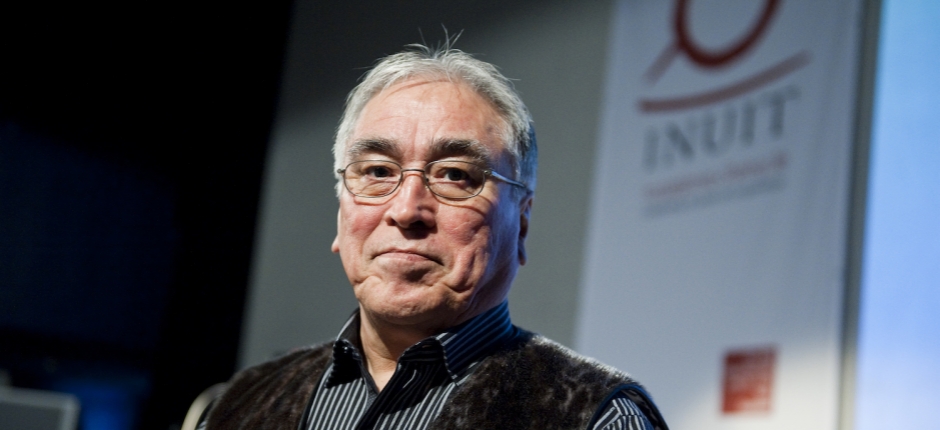
There are few people that have had as profound an influence on Inuit issues as Aqqaluk Lynge.
A social worker who went on to become the chair of the Inuit Circumpolar Council, Lynge, a 66-year-old Greenland native, will step down this week as head the international Inuit organisation he has led for the past four years.
The end of his term comes as Greenland hands over the reins of the ICC to Canada, which will lead the organisation until 2018. But that scheduled transfer of power will also mark the beginning of the end of Lynge’s involvement with the Greenlandic chapter of the ICC as well.
Lynge, who has been the head of ICC Greenland since its founding in 1995, announced earlier this year that the time has come to pass on the torch a younger generation. After stepping down as ICC Greenland chair, he will remain a part of the organisation for another year or so before ending his active involvement with the group entirely.
“I feel very privileged to have been able to work on Inuit issues for this long,” he says. “I have been working in the field for over 30 years and I have seen the development of the Inuit area in a very positive manner and I feel so proud that the ICC has achieved permanent membership in the Arctic Council.”
SEE VIDEO: Aqqaluk Lynge – Faces of the Arctic (at end of article)
There are about 160,000 Inuit living in Alaska, Canada, Greenland and Russia, and it is the work of the ICC to make sure that the voices of these people are heard nationally and internationally. Equally important, though, is to ensure that Inuit are talking to each other and to other indigenous groups.
“I can look back on some very important achievements among indigenous peoples around the world and the ICC has been closely related to those. I can’t say that nothing would have happened without the ICC, but it has certainly been a strong partner in developing co-operation among the many indigenous groups.”
As a young man, Lynge, like so many of his countrymen, left Greenland to study at the University of Copenhagen. It was in the Danish capital, during the height of the Cold War, that he got involved with student organisations and saw how the different nationalities of the North Atlantic were working together.
“My time in Copenhagen showed me how closely the people of the North Atlantic could work together and that made me think, ‘why not Inuit?’”
SEE RELATED: Inu-it’s the economy, stupid
Soon afterwards, in 1973, Lynge attended the first conference for Arctic peoples, held in Copenhagen, and from there the ball started to roll in earnest.
But it can also be said that politics and a pride in his Inuit heritage are something Lynge grew up with; he fondly remembers the influence his grandfather, and the time he spent in his grandparents’ home, had on him as a child.
“My grandfather, who was an author and a politician himself, had a study in his house in the ‘50s, and there I would read his magazines and learn about other Inuit people,” Lynge says. “So I knew that Greenlanders were not alone, that there were other people around the Arctic who were like us. Then, when I was 10, we had a visitor from an Inuit tribe in Canada. That was the first time I met an Inuit from outside Greenland.”
Lynge understood from an early age that Inuit groups had to work together if they were to hope to obtain international recognition. This, he feels, remains just as important in modern Greenland, despite – or maybe because of – the incredible changes that have taken place in his own lifetime.
SEE RELATED: Future of Arctic not as smooth as it appears
“Those of us who were born right after the Second World War have gone through the whole modernisation of Greenland and seen the country develop – for better and for worse,” he says. “Climate change will alter our lives once again – again both for better and for worse. Greenland will see a greater influx of foreign workers, with greater exploitation of oil and gas, and this will change our society profoundly. Dealing with the oil and mining companies will be the next big challenge our country faces.”
Another issue that still remains an unanswered question for Greenland is relationship within the Kingdom of Denmark, which also includes the Faroe Islands. As a young man in the 1970s Lynge was among the founders of Inuit Ataqatigiit, a left-wing political party that fought for Greenland’s independence from Denmark, but now, some 40-odd years later, his views on the issue have changed. Today he takes a more pragmatic view.
“I think there is an understanding now between Denmark and Greenland that we need each other for further development, and that if Denmark weren’t helping us we would need some other form of outside help,” he says. “There are still many areas that Greenland does not have sovereignty over, but mainly the question of independence is an economic one, and if we can’t afford full sovereignty then independence would be filled with problems.”
For Lynge the way forward for Greenland is to make the country an attractive place for foreign investors and to ensure that Greenlanders have the educational resources to help the country establish a developed economy that is sustainable and independent of Copenhagen.
SEE RELATED: ICC Greenland faces shutdown after funding slashed
As he prepares to hand over his life’s work, Lynge can look back on a career dedicated to the people of the Arctic. And as it is with senior statesmen, he has plenty of words of wisdom to pass on to future generations.
“The next generation should be aware of the world around them, and they should concentrate on solidarity and on stabilising the social situation in the Arctic,” he says.
Having lived through the Cold War, it is Lynge’s hope that the fear, the uncertainty and the instability that era brought with it will never return to the Arctic.
“We are not isolated from the world’s conflicts, and we should be aware of the dangers we face should the Arctic be pulled into a conflict like in the Ukraine. My feeling is that everything the Inuit have built up could be taken away if something terrible should happen,” he says.
“But I am optimistic that our connections in the Arctic are based on human relations, and that we can all talk to one another in a peaceful way.”
This article is a part of our Northern Profiles series. Join us each Monday as we profile an Arctic personality, past or present.
Aqqaluk Lynge – Faces of the Arctic from Markus Kaeppeli on Vimeo.