Analysis gone wrong
iAbout Press releases
As part of our continuing efforts to bring you as much information about our region as possible we offer readers a press release service that allows private firms, public agencies, non-governmental organisations and other groups to submit relevant press releases on our website.
All press releases in this section are published in their full length and have not been edited.
If you have a press release or other announcement you would like to have published, please send it to [email protected].
We reserve the right to reject press releases we deem irrelevant or inappropriate.
All material submitted to The Arctic Journal, including pictures and videos, will be assumed to be available for publication by The Arctic Journal and its related entities.
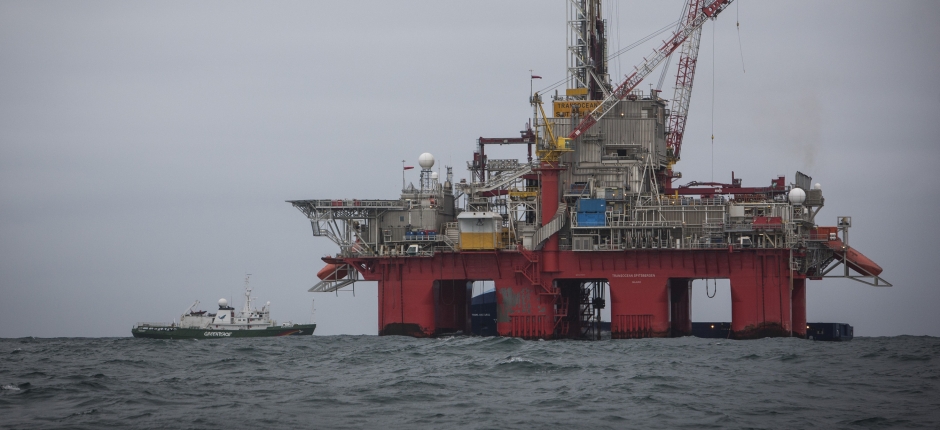
Oil drilling in Arctic waters going hand in hand with environmentalism? A commentator’s task is at times to be provocative and to draw attention to issues in a controversial way (not unlike the role of NGOs). This week, however, Martin Breum misses the target with an elaborated analysis that fails by claiming an undisputed public mandate for the Norwegian oil bonanza, since it should apparently be regarded an environmentally sane form of development in the Arctic.
Mr Breum’s argumentation (based on a recently published book by Leif Christian Jensen) is a two-step approach. Firstly, that the relationship with Russia is important and the key to maintaining this is direct collaboration with the Russians on issues such as fisheries and in particular joint ventures on oil extraction and exploration.
Secondly, that this collaboration, thanks to high Norwegian standards, can be expected to have a positive effect on Russian oil companies at home and abroad, since they will adapt their operations to the Norwegian standards. This is something that Mr Breum also mentions there is little evidence to support so far.
There cannot be any doubt that maintaining a peaceful approach in the Arctic is important, and this of course includes maintaining good relations with Russia, which the fisheries agreement between the two countries from 1974, and the subsequent designations in 2011, are a good example of. But to include the oil exploration in this equation is at best superficial and at worst counterproductive, even if we for a moment ignore the environmental perspective.
It is true that in particular Gazprom’s swap of assets with Austria-based OMV have given the Russian company (and Russia in general) unprecedented access to Norwegian oil exploration as they now have a major share in OMV Norway, including its 33 licenses and a share of the Polarled pipeline.
But we are at the same time seeing that the 23rd licensing round in Norway includes areas adjacent to the Russian border, where any oil fields might will cross the border, thus holding the potential to reignite conflict. In fact, Russia has – already before the licensing round is concluded – warned Norway that three of the blocks in question violate the Svalbard Treaty.
This, combined with the risk of future sanctions against Russian oil companies, underscores that increased oil exploration in the Norwegian Arctic in collaboration with Russian oil companies won’t necessarily ensure a stable relationship between the two countries.
SEE RELATED: Not so much a reversal as a stall
Another main point in Mr Breum’s analysis is that collaboration, due to the high Norwegian standards, could have a positive spill-over on Russian oil operations as well. Mr Breum himself refers to the fact that there is little evidence to substantiate that argument, but it would be fair to go a whole lot further, since there is plenty of evidence of the opposite.
National oil regulations rarely have impact on a company’s behaviour abroad. Instead oil companies will do their utmost to lower the bar as soon as they can. If we take a look at foreign operations of Western companies, there is a very long list of crimes committed against the environment and populations as soon as companies didn’t have to comply to the rules back home. (Shell’s operations in Nigeria, Texaco’s in Ecuador and Lundin Oil’s in Russia are but three examples.)
At the same time, regular spills in Russia (on average about one spill a day) have nothing to do with lack of ability or technological know-how. Instead, they are the result of indifference and gross negligence as pipelines are allowed to corrode, polluting the soil, rivers and pastures.
Not least, there is no guarantee whatsoever that implementing Norwegian standards will prevent accidents in ice-covered waters. Even though Norway has almost no experience with offshore oil exploration in ice-covered waters (something which the 23rd licensing round unfortunately will change) there is still a vast list of spills and accidents from operations in their waters.
SEE RELATED: Another nail in the coffin of Greenland’s Arctic oil hunt
None of these are the size of the BP disaster in the Gulf of Mexico or the Valdez accident, but they are numerous and have happened despite taking place under easier conditions than the harsh Arctic provides.
Shell’s recent experiences of operating in Alaska spells out clearly that operating in these areas are nothing like what the oil industry has been used to. These took place under US regulations after the BP spill and by one of the world’s most experienced oil companies (which, by the way, has withdrawn from the 23rd licensing round because it didn’t think it was worthwhile, but that’s a different story).
Of course the Norwegian state and Statoil need to convince the public that engaging with these companies, which run roughshod over basic environmental and human concerns, will improve the standards back home in Russia.
But no matter how often they try to tell this story, it does not change the fact that the only goal of their sales pitch is to enable continuded progress down a path that will greenwash some of the dirtiest companies on the planet, increase the risk of a devastating oil spill in ice-covered waters and, indirectly, lead to catastrophic climate change. That is why there simply is too much at stake for the environmental movement to be stymied by the Norwegian propaganda machine.
The author is a Greenpeace Arctic campaigner.