Always a byway
iAbout Press releases
As part of our continuing efforts to bring you as much information about our region as possible we offer readers a press release service that allows private firms, public agencies, non-governmental organisations and other groups to submit relevant press releases on our website.
All press releases in this section are published in their full length and have not been edited.
If you have a press release or other announcement you would like to have published, please send it to [email protected].
We reserve the right to reject press releases we deem irrelevant or inappropriate.
All material submitted to The Arctic Journal, including pictures and videos, will be assumed to be available for publication by The Arctic Journal and its related entities.
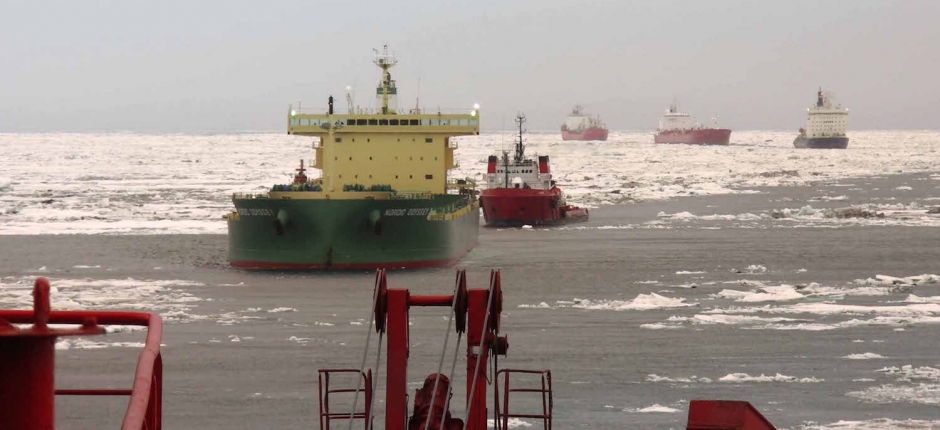
Receding sea ice and increasing economic activity ought to mean more traffic on Russia’s Northern Sea Route. In general, it has: as many as 600 permits are now issued annually to ships wishing to sail all or part of the 5,500km waterway along the country’s northern coast.
Cargo volumes have followed suit, rising more than four-fold, to about four million tonnes, since 2011. That has given Moscow high hopes for the waterway’s potential; in the next 15 years, it expects volumes to increase 20-fold to 80 million tonnes. Getting there, however, may prove more of a challenge than the Kremlin initially imagined.
“It is the shortest route linking Europe with the Far East, the Asia-Pacific region and the western part of North America,” Dmitry Medvedev, the prime minister, said during a meeting with his deputies on Monday. “To put it mildly, its use is not so hot, I admit it. It was used more extensively before.”
SEE RELATED: From short-cut to long-shot
While Mr Medvedev is right about traffic volumes, he is only partly right about the distance.
Local traffic continues to form the majority of traffic on the Northern Sea Route (watch the film below to see this visualised), and many of these vessels are Russian-flagged, according to official statistics. While that is an indication of lively mining and drilling activity, it shows that there is plenty of room to improve, especially in the number of ships sailing the entire distance.
Though generally on the uptick as word of the short-cut has circulated, the volume of transit traffic still fluctuates considerably. Last year the number of ships transiting fell to 22, less than a third of the number making the voyage in 2013.
When it comes to distance, there are indeed savings to be had, but they are not as attractive for everyone. For traffic two and from north-eastern Asian ports, there is a considerable amount to gain. For cities to the south, on the other hand, the northern route would be a detour.
SEE RELATED: Editor’s Briefing | Shipping
Falling in the middle are ports for which there are savings on distance, but perhaps not on cost or time. When sailing north, shippers must consider factors such as slower sailing speed, hull requirements and the lack of infrastructure. For ships sailing from these fringe ports with certain types of cargo, or faced with potentially adverse conditions, the long way remains the preferred route for now.
Several new initiatives to be undertaken as part of the Northern Sea Route Comprehensive Development Project, signed by Mr Medvedev on Monday, may change that by pledging to address shortcomings in navigational support, port facilities, maritime traffic regulation and search and rescue.
Also of assistance will be the planned launch of three nuclear-powered ice-breakers, the first of which is due to come into service in 2017. Renewing the fleet will make it possible to keep the route open later in the year, and, perhaps, provide the Northern Sea Route with the boost it needs to live up to Moscow’s expectations.