There and back again
iAbout Press releases
As part of our continuing efforts to bring you as much information about our region as possible we offer readers a press release service that allows private firms, public agencies, non-governmental organisations and other groups to submit relevant press releases on our website.
All press releases in this section are published in their full length and have not been edited.
If you have a press release or other announcement you would like to have published, please send it to [email protected].
We reserve the right to reject press releases we deem irrelevant or inappropriate.
All material submitted to The Arctic Journal, including pictures and videos, will be assumed to be available for publication by The Arctic Journal and its related entities.
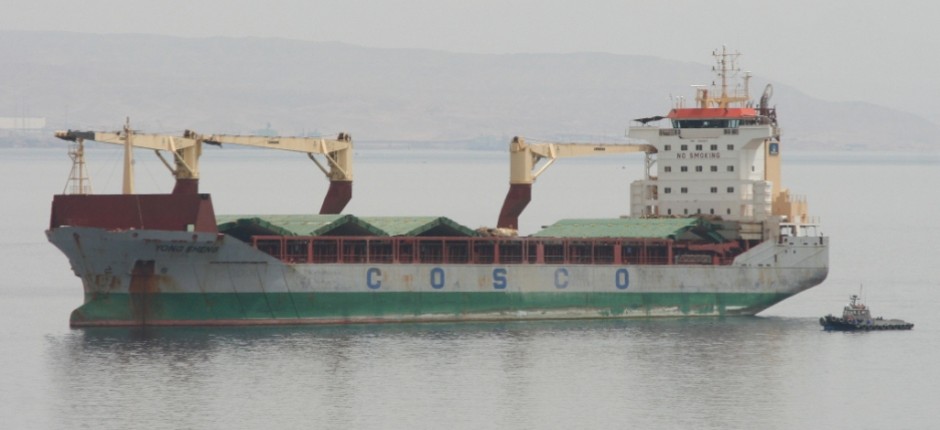
This week, the Chinese cargo vessel M/V Yongsheng arrived in the Swedish port of Varberg after departing from the port city of Dalian on July 8 and traversing the Northern Sea Route (NSR).
This was the second time the vessel made use of the Arctic waterway, the first taking place in August-September 2013 which involved a voyage from the port of Taicang to Rotterdam, a trip which lasted 27 days, or about ten days less than using the traditional routes between China and Europe via the Indian Ocean.
The Yongsheng, originally built in 2002 and operated by the China Ocean Shipping (Group) Company (Cosco), was the first Chinese ship to complete such a journey. After offloading its cargo of wind turbine components and steel, the merchant vessel is expected to return to China by October via the NSR, thus marking the first time the ship is making a round-trip using that route. The vessel had been modified to handle the extreme conditions of the Arctic region, and has since become a symbol of Beijing’s growing interest in developing a diplomatic and economic presence in the Far North.
SEE RELATED: North by north-east
When the Yongsheng, weighing in at more than 19,000 tonnes deadweight, made its first visit through the NSR two years ago, international debate and speculation about an ‘Arctic boom’ was reaching a fever pitch. Since that time, however, there has been a considerable drop in global energy and commodity prices, which has made many plans for Arctic development more expensive.
As well, the current environmental obstacles to widespread use of the NSR became apparent in 2014, when poor conditions resulted in a considerable drop in the number of vessels making the transit compared with the previous year. This year’s transit conditions also looked to be mixed, with the melting season off to a slow initial start due to colder weather, but with the NSR open for potential navigation by mid-summer.
Debate remains robust as to when exactly the route will be open for more extensive usage, but many countries, including China and other Asian economies, Japan, Singapore and South Korea among them, have been preparing for the time when trans-Arctic shipping becomes more commonplace. The opening of the NSR will provide new opportunities for Beijing to expand European trade, taking advantage of the shorter distances lower fuel costs.
SEE RELATED: From China, with strings attached
China’s growing interest in deepening exports with Europe, Greater Eurasia and Russia was well-illustrated since 2013, when Chinese president Xi Jinping began to introduce his government’s plans, known as the ‘one belt and one road’ (OBOR) policies, to develop cross-continental trade routes for China both on land and at sea.
At the same time, China’s interest in the NSR is also a product of warming relations with Moscow, and in May 2014 a joint statement on strategic co-operation signed between the two powers included promises to build economic and transport networks involving the route as well as the greater Russian Far East.
Although it is unlikely that the Arctic transit routes will assume the same level of importance for Beijing as planned trade routes across Central Asia and the Indian Ocean, at least in the short-term, it is nonetheless a probability that the NSR will play a greater role in Sino-European trade as summertime access to the route becomes more commonplace due to climate change.
The author is a senior research fellow at the Norwegian Institute of International Affairs (NUPI) in Oslo.