The claim game
iAbout Press releases
As part of our continuing efforts to bring you as much information about our region as possible we offer readers a press release service that allows private firms, public agencies, non-governmental organisations and other groups to submit relevant press releases on our website.
All press releases in this section are published in their full length and have not been edited.
If you have a press release or other announcement you would like to have published, please send it to [email protected].
We reserve the right to reject press releases we deem irrelevant or inappropriate.
All material submitted to The Arctic Journal, including pictures and videos, will be assumed to be available for publication by The Arctic Journal and its related entities.
The Kingdom of Denmark is claiming a total of 895,000 square kilometres of ocean floor in the Arctic Ocean, far more than expected. The governments in Denmark and Greenland, which are jointly submitting the claim, have chosen to exploit their options in the ocean to the greatest extent possible.
Their claim to the ocean floor, which will be presented to the UN on Monday, extends not only to the North Pole and across to the Russian side of the pole, as was expected, but all the way to Russia’s maritime border, only 200 nautical miles from the Russian coast. Overlap between the Danish-Greenlandic claim and Russia’s own forthcoming claim was expected, but the size of what is now likely to be the overlap is hundreds of thousands of square kilometres larger than previously projected.
Russia has been forewarned of the claim and no formal protests are expected, but we have still to learn how Russia will shape its own claim in response. Some observers already wonder if Russia will now extend its claim all the way to Greenland’s territorial waters, creating an even greater overlap.
Copenhagen’s position is that Moscow will find it only natural that the Danish-Greenlandic claim seeks to grab as much of the ocean floor as the UN Convention on the Law of the Sea permits. Other states are doing the same around the world. Canada, in a surprise move, recently announced that it would extend its claim in the Arctic so that includes the North Pole (but not necessarily ocean floor all the way to Russian waters).
SEE RELATED: The indispensable island
Martin Lidegaard, the Danish foreign minister, recognises that diplomats will now have their work cut out for them. Firstly, they will need to explain to the public why the Danish government finds the potential for conflict over competing claims in the Arctic almost non-existent. Then, they face the prospect of difficult negotiations with Russia, if and when the UN’s experts confirm the claims of both countries. Other than that, however, the Danes expect no reaction from Russia.
Danish diplomats are keen to point out that, in 2008, Russia, together with the leaders of the four other Arctic coastal states, signed the Ilulissat Declaration, in which they pledged to abide by UN guidelines when resolving their claims in the Arctic Ocean. Danish diplomats also note that in 2010 Russia peacefully established a maritime border with Norway in the Barents Sea, bringing an end to 40 years of disagreement. Russia, it is said, has every interest in peacefully establishing its borders in the Arctic, since the vast majority of the ocean floor that Moscow will claim will not be contested by other states. If UN guidelines are respected, Russia will automatically be awarded enormous tracts of ocean floor, regardless of the relatively smaller pieces also contested by Copenhagen and Ottawa.
Moscow will also seek to keep the peace in the Arctic, Denmark expects, because instability will hinder its plans to develop its oil, natural gas and mineral reserves in the region. Peace in the region is so important to Moscow that it will go to lengths to avoid letting conflict over Ukraine or disputes over ocean floor disrupt the Arctic calm, officials in Copenhagen reckon. The Danish-Greenlandic claim means Russia could eventually win a significantly smaller piece of ocean floor than expected, but, say Danish diplomats, this will not affect Russia’s overall priorities.
SEE RELATED: Be prepared for realpolitik over arktik politik
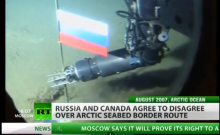
Back in 2007, two Russian mini-subs planted a Russian flag on the ocean floor at the North Pole. The now famous event led to extensive worry about Moscow’s intentions. The Danes, though, also discount the event as grounds for pessimism. Firstly, the operation was officially co-ordinated by private operators, not the Russian government. Secondly, the operation was partly backed by a Danish-Swedish financier. Thirdly, the mission carried two members of the Explorers Club in New York. Lastly, as Sergei Lavrov, Russia’s foreign minister, explained, America’s flag-planting on the Moon did not lead to claims by Washington that it belonged to the US.
It is for this reason that Danish officials, during a recent press briefing on the North Pole claim, did not bring up the assessment put forward in October by the FE, the external intelligence service. In its annual risk assessment, the FE reiterated that the interest the Arctic states have in the economic development in the region makes conflict highly unlikely. It did, however, warn that competing claims to the ocean floor could result in heightened tensions. The FE claimed that Russia could choose to pursue its national interests in the Arctic in ways that were not necessarily in line with its short term economic objectives, if current trends did not meet Moscow’s expectations.
The next chapter will be written when Russia – possibly next year – submits its final claim to the ocean floor in the Arctic. In 2001, Moscow submitted a claim that included 1.2 million square kilometres of ocean floor. The claim stretched from the edge of Russia’s 200 nautical mile limit and ended like the tip of a pizza slice, with its apex at the North Pole itself. Moscow made no claims to ocean floor on the Greenlandic side of the Pole.
That claim was returned to Moscow by the UN, which said it lacked sufficient technical data. Russian officials are currently working to obtain the information, and we won’t know what their final claim is until it is resubmitted. What we know now, however, is that the Danish claim overlaps about a third of Russia’s original claim. Some observers find it reasonable to assume that Russia will respond by expanding its claim as far as possible past the North Pole and towards Greenland.
That, however, is not how the Danes expect it to play out. Russia, they say, will stick with its 2001 claim. Russia usually follows a strict routine of setting down straight sector claim lines when it is involved in delineation issues at sea. Danish diplomats believe Russia will not change its ways just to match Copenhagen tit for tat.
The Danish-Greenlandic claim is based on extensive scientific expeditions to the North Pole and the surrounding seas over the past decade and involving icebreakers, aeroplanes and sophisticated technology. A large part of the claim closet to Russia, however, is based only on publicly available scientific data collected by American submarines and by other means.
SEE RELATED: Denmark makes new claim to Arctic seafloor
For officials in Nuuk, the claim is regarded as important to Greenland’s future. When self-rule was introduced in 2009 all rights to offshore natural resources passed from Copenhagen to Nuuk, and any future discoveries will benefit Greenland directly.
The few available geological surveys of the ocean floor in the central part of the Arctic Ocean would seem to rule out the prospect of finding oil or gas, but the governments in both Nuuk and Copenhagen have long held that this was no reason to hold back when submitting their claim.
The author is a Danish journalist who has written extensively about Arctic issues, including “When the ice disappears – Denmark as a major power in the Arctic, the riches of Greenland and the quest for the North Pole. In 2012 he participated in the Danish-Greenlandic LOMROG-III science expedition to the North Pole.