Confusion over details of China firm’s mine investment
iAbout Press releases
As part of our continuing efforts to bring you as much information about our region as possible we offer readers a press release service that allows private firms, public agencies, non-governmental organisations and other groups to submit relevant press releases on our website.
All press releases in this section are published in their full length and have not been edited.
If you have a press release or other announcement you would like to have published, please send it to [email protected].
We reserve the right to reject press releases we deem irrelevant or inappropriate.
All material submitted to The Arctic Journal, including pictures and videos, will be assumed to be available for publication by The Arctic Journal and its related entities.
Greenland’s Kvanefjeld project is known for kicking up its fair share of debate. Mostly, it has been for geological reasons: the site could be world's second largest deposit of rare earths, key inputs for many high-tech products. But uranium is also found in the area, and, in 2013, the national assembly adopted a law permitting radioactive minerals to be mined, allowing the project to proceed.
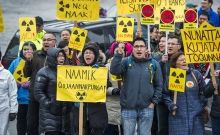
The measure passed by a single vote, however, and opponents of the mine have continued to work against it, citing the threat radioactive dust created by the operation poses to a nearby town.
With the announcement last week that Shenghe Mining, a state-controlled Chinese firm, had agreed to purchase a share of Greenland Minerals and Energy, the firm developing the project, the discussion has become less about what is in the ground and more about what are the true details of the agreement between the two companies.
SEE RELATED: It’s the transparency, stupid
In their respective announcements, both state that Shenghe will purchase a 12.5% share of GME. Shenghe’s announcement, written in Chinese, also states that the company has been granted an option to purchase 60% of GME.
GME’s announcement, published in English, does not mention the option. It blames any confusion about whether Shenghe has the right to purchase more of the company on the Danish media, which it says failed to properly interpret Shenghe’s announcement.
“Shenghe is just looking to become a shareholder in Greenland Minerals and Energy Ltd. We will then commence cooperation to enhance the project,” John Mair, GME’s s managing director, said in a written statement sent to Sermitsiaq, a Greenlandic weekly published by The Arctic Journal’s parent company.
SEE RELATED: From China, with strings attached
Politiken, the Danish news outlet that first reported that difference between the two annoucements, said it based its report on a translation by a Chinese speaker with legal experience.
Another comparison, this one by, Jichang Lulu, a long-time blogger who has written extensively about China’s engagement with the North, found that the Shenghe version contains two passages stating the company had been granted an option.
Although ambiguous in an English translation (“After the Kvanefjeld project has obtained an exploitation permit and completed technical optimisation, on the basis of commercial terms that will be negotiated between the two sides, Shenghe Resources may choose to acquire an interest in the project not exceeding 60%.”), the language in the original version (“在科瓦内湾项目取得采矿证且技术优化完成后,基于双方届时洽谈的商业条款,盛和资源可选择收购不超过60%项目权益.”), would, according to Jichang Lulu, indicate that GME was under no obligation to honour a Shenghe request to purchase more shares.
Shenghe, Mr Mair confirmed, does indeed hope to be a “long-term” partner in the project, and will consider further investments based on the mine’s performance. But, he added in his statement to Sermitsiaq, “this depends on the outcomes of a number of endeavours and activities. There are no contractual obligations on either party, beyond Shenghe becoming a 12.5% shareholder in (GME).”
SEE RELATED: Editor’s Briefing | Will the real Huang Nubo please stand up?
Mr Mair viewed Shenghe’s involvement in the Kvanefjeld project as “positive for Greenland”, and wrote that the firm believed it marked the beginning of “a positive co-operation”.
But the deal also benefits GME, particularly if it includes a purchase option, reckons Jichang Lulu. If it would have made sense for the company to to talk that aspect up, downplaying it does to, given the controversy over the mine, which ranges well beyond environmental concerns.
Shenghe, for example, is just the latest Chinese mining firm to purchase a significant share of a Greenlandic mining project in recent years. In January 2015, for example, General Nice took over the Isua project, one of the world’s largest deposits of Iron ore.
Though welcomed by many in Greenland for their potential to get the country’s mining industry off the ground, such investments also raise security concerns, particularly in Copenhagen, which retains responsibility for Greenland’s foreign affairs. Some also fear that the arrival of Chinese firms means Beijing will gain undue influence in the Arctic, similar to the way it has in Africa.
Greenland’s Mining Ministry last week said it will investigate the discrepancy between the two announcements. It may find that the investment has less to do with politics than it does with business. China already holds a near monopoly on rare earths. Shenghe’s investment, though a marginal $3 million, could turn out to be a good down payment on keeping it that way.
With additional reporting by Trine Juncher Jørgensen, Sermitsiaq.
Latest news