Greenland opens second onshore licensing round
iAbout Press releases
As part of our continuing efforts to bring you as much information about our region as possible we offer readers a press release service that allows private firms, public agencies, non-governmental organisations and other groups to submit relevant press releases on our website.
All press releases in this section are published in their full length and have not been edited.
If you have a press release or other announcement you would like to have published, please send it to [email protected].
We reserve the right to reject press releases we deem irrelevant or inappropriate.
All material submitted to The Arctic Journal, including pictures and videos, will be assumed to be available for publication by The Arctic Journal and its related entities.
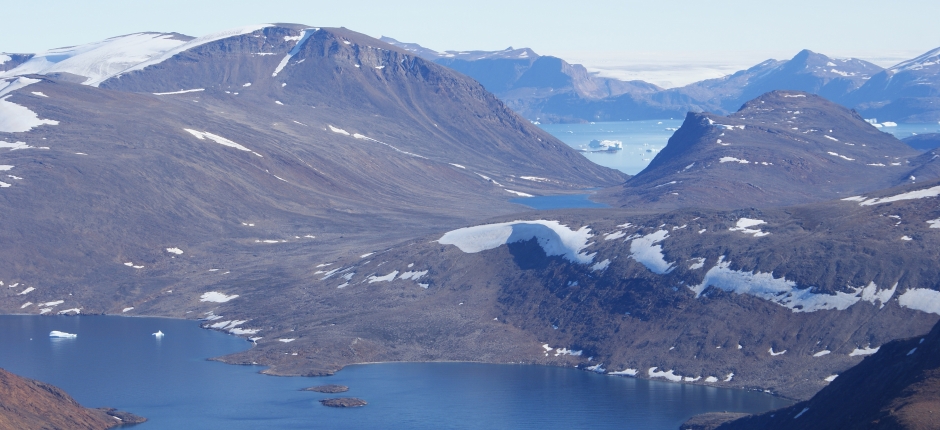
Greenland has opened its second licensing round for onshore oil and gas exploration. The 13,000 sq km area covering Disko Island and the Nuussuaq Peninsula (pictured above) on Greenland’s western coast is made up of three licence blocks.
“It’s not a big area, so this isn’t going to save our economy, but it is a step in the right direction. We’re anxious for it to get under way,” said Jørgen Hammeken-Holm, the head the Bureau of Minerals and Petroleum.
Informational meetings to pitch the area to exploration firms were held earlier this year in London and Calgary. Bureau officials say they were pleased with the number of people who turned up at the meetings, as well as the diversity of companies that were represented.
According to Mr Hammeken-Holm firms with experience in Greenland as well as new faces had expressed interest in submitting a licence application by the December 15 deadline.
SEE RELATED: Oil firms in Greenland: “we’re still here”
An assessment drawn up in connection with the licensing round identified seismic testing and drilling as the most damaging activities expected to be carried out during exploration, given their potential to disturb the surface and vegetation. The evaluation was based on 1996 exploration activity in the Nuussuaq area, where tyre tracks from ATVs can still be seen.
In addition, the assessment recommends that firms granted licences be required to meet the highest environmental and safety standards.
Although onshore drilling is generally not associated with the same level of environmental risk or technical difficulty, firms granted licences will still face a number of challenges, according to Flemming Getreuer Christiansen, the deputy director of Geus, the Danish and Greenlandic geological survey.
“It is difficult territory to operate in,” he said. “Disko Bay is covered in ice for much of the year and that poses logistical and infrastructure challenges.”
Even so, he reckoned that firms granted licences during the current would have an easier time operating there they would have in the 1980s and ‘90s, when several test wells were drilled.
“There is less ice today. That makes Disko Island and Nuussuaq much easier places to look for hydrocarbons,” he said.
Greenland first opened up an onshore drilling area in Jameson Land, on the north-eastern coast, in 2014. Other onshore drilling projects are also taking place in Alaska, Canada and Siberia, and it is these areas that the newly opened licence area will compete with, according to Mr Christiansen.
Firms that are granted exploration licences will have the right to search for oil or gas for 10 years. Should they make a find worth pursuing commercially, they can be awarded a 30-year extraction licence.
This article originally appeared in Sermitsiaq, a Greenlandic newspaper published by the parent company of The Arctic Journal.