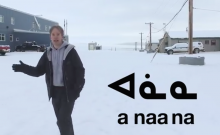
You say ‘ᐊᓈᓇ’, I say ‘anaana’
iAbout Press releases
As part of our continuing efforts to bring you as much information about our region as possible we offer readers a press release service that allows private firms, public agencies, non-governmental organisations and other groups to submit relevant press releases on our website.
All press releases in this section are published in their full length and have not been edited.
If you have a press release or other announcement you would like to have published, please send it to [email protected].
We reserve the right to reject press releases we deem irrelevant or inappropriate.
All material submitted to The Arctic Journal, including pictures and videos, will be assumed to be available for publication by The Arctic Journal and its related entities.
For those with a fear of foreign languages, the syallabics of Inuktitut must invoke nightmares.
Developed by British language experts and missionaries in the latter half of the 19th century as a way to write the language spoken by Canadian Inuit, the system of triangles, curves and diacriticals appear, to the uninitiated, not just foreign but positively alien.
Even for those who use Inuktitut syallabics, they pose a number of challenges. As with other non-Roman alphabets, writing syallabics on a standard keyboard requires special methods. (Although smartphones and tablets ease this somewhat.)
Likewise, not all dialects of Inuktitut (of which linguists reckon there are nine) use syallabics (nor do any of the three Greenlandic dialects of the Inuit language). This was one of the main reasons why language experts, last year, suggested eliminating them as part of a wider language reform.
Doing so would make the language more approachable to those accustomed with letters. It is also argued that it would make the language easier to learn, particularly for those acquiring it as a second language. It’s hard to argue with experts, but this week’s two videos show that the writing system that looks like it comes from another planet appears to be an out of this world linguistic creation.
Latest news