Sea Shepherd fined for 2015 Faroese whale protest
iAbout Press releases
As part of our continuing efforts to bring you as much information about our region as possible we offer readers a press release service that allows private firms, public agencies, non-governmental organisations and other groups to submit relevant press releases on our website.
All press releases in this section are published in their full length and have not been edited.
If you have a press release or other announcement you would like to have published, please send it to [email protected].
We reserve the right to reject press releases we deem irrelevant or inappropriate.
All material submitted to The Arctic Journal, including pictures and videos, will be assumed to be available for publication by The Arctic Journal and its related entities.
A court in the Faroe Islands has ordered the Sea Shepherd Global, a marine conservancy, to pay 200,000 kroner ($30,000) in fines for a 2015 incident in which members of the organisation sought to interfere with whale hunters.
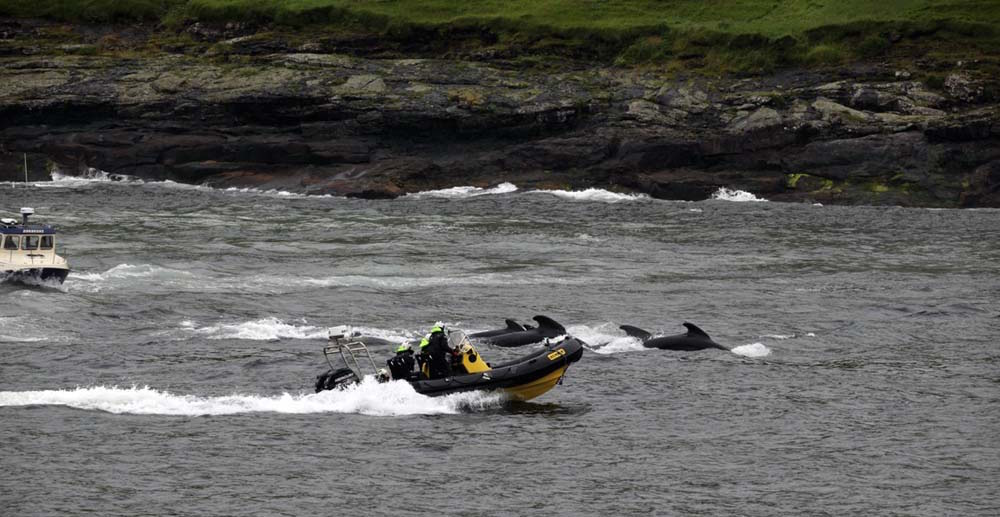
Sea Shepherd was charged in connection with an August 12, 2015 incident in which prosecutors said it violated laws against interfering with the grindadráp whale hunt by running a speedboat in between whalers’ vessels as they sought to surround a pod of pilot whales before driving them ashore.
Prosecutors argued that, in addition to disrupting the hunt, the manoeuvre also put two police officers and a 10-year-old boy participating in the hunt in harm’s way.
SEE RELATED: Out of our backyard
Five Sea Shepherd members on land were also arrested during the incident after they ran into the water in order to position themselves between the whales and the hunters.
In addition to the fine, the Sea Shepherd speedboat that was used in the incident (pictured above) and later impounded in the Shetland Islands will remain in the possession of Faroese authorities.
Sea Shepherd has previously faced legal action for similar incidents in the Faroe Islands, including one that took place on August 7, 2015. That ruling was appealed to the Danish High Court, but the decision was upheld.
No representatives from Sea Shepherd were present in the court to receive the most recent decision, which was handed down on September 23, ruling out any chance of appeal.
The two 2015 incidents were among the first to go to trial after the Faroe Islands adopted tougher laws aimed at preventing the whale hunt from being disrupted. In addition being able to assess higher fines deny entry to activists, the changes also authorise authorities to prevent vessels from entering Faroese coastal waters if they suspect its intention is to prevent whale hunting.
SEE RELATED: Equal, but opposite
Sea Shepherd has mounted six campaigns against the grindadráp since the 1980s. The tougher laws were passed after increasingly tense run-ins between hunters and Sea Shepherd, which initially resulted in the Danish navy to deploy a warship to keep the organisation's vessels away from whale hunts.
Sea Shepherd did not organise protests in the Faroe Islands this year. Instead the organisation has focused its efforts on pressurising the country indirectly, in part by lobbying tourism firms to steer travellers clear of the country.
The organisation has also suggested that the country’s salmon farms use feed produced from whale carcasses. Faroese fish farmers say the claim is baseless.
Sea Shepherd is also in the process of using the courts to argue that, as a member of the Kingdom of Denmark, the Faroe Islands are subject to the EU’s blanket ban on whaling.
While the Faroe Islands are not a part of the EU, and have a 2013 Brussels trade embargo to show as proof of this fact, Sea Shepherd points out that the matter is less clear, given that Copenhagen’s legal and material aide to Tórshavn allows the grindadráp to take place.
Despite the change of tactics, Sea Shepherd continues to pursue its convictions with as much zeal as ever. For now, though, all it has to show for its efforts are convictions of another sort.