A tale of three outfits
iAbout Press releases
As part of our continuing efforts to bring you as much information about our region as possible we offer readers a press release service that allows private firms, public agencies, non-governmental organisations and other groups to submit relevant press releases on our website.
All press releases in this section are published in their full length and have not been edited.
If you have a press release or other announcement you would like to have published, please send it to [email protected].
We reserve the right to reject press releases we deem irrelevant or inappropriate.
All material submitted to The Arctic Journal, including pictures and videos, will be assumed to be available for publication by The Arctic Journal and its related entities.
September 30 was a watershed day of sorts for Greenland. The politically minded will note the date as the end of the end for the government of Aleqa Hammond, who had been caught up in allegations of misuse of public funds.
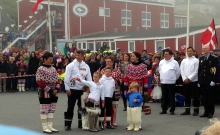
For those whose pre-occupations tend more to the cultural, the date will stand out for an entirely different reason: it was the day Hammond appeared in public wearing the traditional dress of eastern Greenland.
As native of Uummannaq, on the western coast, Hammond was more recognisable in the red silken blouse and beaded shawl most typically recognised as women’s national dress. It was this outfit she wore during the 2013 opening session of parliament, her first as premier, and it was the one she had appeared in countless times during the succeeding 18 months, including during the visit this summer of the Danish royal couple.
MORE PICTURES at end of article
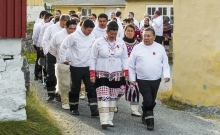
But as she trudged from the church service celebrating the opening of parliament to the building that houses the Inatsisartut assembly, Hammond stood out, mostly for her downcast expression, but just as much for the white blouse of the eastern Greenlandic regional outfit.
The choice of wardrobe was more than just a fashion statement. Her government had just unveiled its governing platform, ‘A unified country – a unified nation’, and her outfit was meant to punctuate the message.
In addition to the western and eastern variants of the outfit, there is a third women’s outfit, worn in the Avanersuaq region of extreme north-western Greenland, also known as Thule. (For gentlemen, the outfit is almost uniformly a white anorak and black trousers, though polar-bear-skin leggings are worn by some.)
SEE RELATED: Open mouth, insert kamik
Those that specialise in trends related to the national outfit note that Hammond is but the latest, if most prominent, western-Greenlandic woman to wear an outfit from an area she does not have ties to.
Aviâja Rosing Jakobsen, of Kalaallisuuliornermik Ilinniarfik, the Greenlandic institute of national costumes, in Sisimiut, said much of it had to do with personal preference. “All three regional styles are beautiful,” she says.
Nevertheless, she also underscored that as Greenland gained more political independence, people had become more interested in the national outfit, and that had led to the development of more personalised styles.
SEE RELATED: Better than a #sealfie
Jakobsen and her colleagues have discussed the trend but their position is simple: there are no rules.
“We all agreed that women have the full right to wear whatever clothing they want. But even if there were rules, it would be extremely hard to enforce them,” she admits.
For some modern women, fiddling with the finer details of their national costume without swapping it out entirely is personalisation enough. Jakobsen points out that, traditionally, married women wear long, red kamik boots with ornamentation at the knee. Older women, on the other hand, normally wore blue kamik boots.
Nowadays, the distinction is all but gone. “Even young women incorporate such details,” Jakobsen says. “Women want to wear nice outfits. No-one is going to get upset about that.”
VIDEO: Nuuk is haaaappppieee ...
In addition to a greater sense of political awareness among Greenlanders, Jakobsen reckons that much of the trend is inspired by changing social structures. People no longer need to wear hides, and because they are less nomadic they feel a need to distinguish themselves by the clothes they wear.
“In the past, people moved all around the country depending on the season, so they didn’t need to use their clothing to show that they came from a specific area.”
The changes, she says, are possible because the national costume has the capacity to be renewed. That may be the true beauty of its design.
greenland-national-outfit-2_leiff-josefsen.jpg.jpg

hammond-royals-nuuk_bibi-nathansen.jpg