Doing something about the forecasting, at least
iAbout Press releases
As part of our continuing efforts to bring you as much information about our region as possible we offer readers a press release service that allows private firms, public agencies, non-governmental organisations and other groups to submit relevant press releases on our website.
All press releases in this section are published in their full length and have not been edited.
If you have a press release or other announcement you would like to have published, please send it to [email protected].
We reserve the right to reject press releases we deem irrelevant or inappropriate.
All material submitted to The Arctic Journal, including pictures and videos, will be assumed to be available for publication by The Arctic Journal and its related entities.
Tweet by DMI employee Katrine K Andersen (@dk_katrine) during power-up ceremony in April
“@Thyrring. The belle of the ball. Thor and Freya @dmidk new supercomputer in strong relationship with #IMO”
@Thyrring. Dette er så festens midtpunkt: Thor og Freya @dmidk ny supercomputer i stærkt samarbejde med #IMO. pic.twitter.com/xED7rppmFg
— Katrine K Andersen (@dk_katrine) April 28, 2016
After successfully moving its weather-modelling supercomputer to Iceland earlier this year, DMI, the Danish met, is well on its way to improving its weather and ice forecasting in the North Atlantic.
In addition to saving energy costs for DMI, placing the computer at Veðurstofa Íslands, the Icelandic met, has allowed the two weather outfits to collaborate to develop a more precise weather model that has improved long-range forecasting in Greenland. Collaborating with the Danes is also expected to improve weather forecasting in Iceland, which often sees its weather influenced by Greenland.
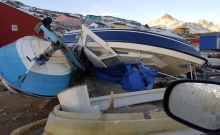
One of the most important benefits of the new model will be an improved ability to predict dangerous weather conditions, including a phenomenon known as piteraq, a type of windstorm that sweeps down from Greenland’s icecap to its eastern coast, often with destructive force. The most recent of these occured in November, bringing with it windspeeds approaching 250km/hr (photo above).
Fishing vessels and airlines can also expect to benefit from improved forecasting when travelling near or over Greenland, thanks to improvements such as up-to-date reports of local wind conditions.
Ice forecasting is also expected to be improved with the development of the new weather model. However, while DMI has relied on more powerful computing to better its weather forecasting, improving ice-forecasting been achieved in part by asking users about their needs, according to Marianne Thyrring, the organisation's director.
In addition to forecasting the weather, DMI is also stepping up efforts to improve its predictions for how global warming will affect Greenland’s climate.
“This is an area where we want to gain a better understanding of what happens to the ice cap when the earth’s temperature rises,” Ms Thyrring said.
SEE RELATED: Putting the wheels on climate talks
This, in turn, should allow DMI to give Greenlandic authorities more detailed information about how the climate will affect specific parts of the country.
One such report, presented in November, set out scenarios for how the climate in Greenland would look in 2020, 2050 and 2100 as a way to help authorities guide their long-term decision making.
This article originally appeared on sermitsiaq.ag, a Greenlandic website operated by the parent company of The Arctic Journal.
Latest news