Despite cool summer, sea ice ends near record low
iAbout Press releases
As part of our continuing efforts to bring you as much information about our region as possible we offer readers a press release service that allows private firms, public agencies, non-governmental organisations and other groups to submit relevant press releases on our website.
All press releases in this section are published in their full length and have not been edited.
If you have a press release or other announcement you would like to have published, please send it to [email protected].
We reserve the right to reject press releases we deem irrelevant or inappropriate.
All material submitted to The Arctic Journal, including pictures and videos, will be assumed to be available for publication by The Arctic Journal and its related entities.
Despite not setting a record low, this year’s annual sea-ice minimum continued a worrying trend that now has seen the 10 lowest extents all occurring in the past ten years (see table below).
Much as expected, sea-ice extent this year was the second-lowest measured since 1979, when satellite record-keeping began, a number of sources are reporting, including the National Snow and Ice Data Center, a Colorado-based research outfit.
The minimum extent ended in a statistical tie with 2007, and was about 10% lower than was measured in 2015, which was the fourth lowest on record.
SEE VIDEO: Seven surprising results from the reduction of Arctic Sea ice cover (at end of article)
After setting a second consecutive record in March for the lowest annual maximum extent, it was expected the summer minimum would be close to the 2012 record. However, a summer that was “stormy, cloudy and fairly cool” likely prevented that from happening, said Mark Serreze, the director of NSIDC, in a statement issued today.
Typically, those conditions would result in a summer minimum that was near or above average. The fact that this year was still close to a record means that should coming years see conditions more conducive to ice loss, the result would be “dramatic”, according Ted Scambos, also of the NSIDC.
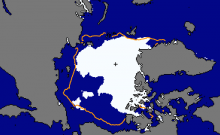
Sea-ice loss was particularly heavy along the Siberian coast, in the Kara Sea, as well as in the East Siberian and the Beaufort seas. The loss, however, was not uniform: other areas, including the area around Svalbard, saw normal to above-average ice extent. (See animation below.)
SEE RELATED: What a warm, crazy winter it’s been
In addition to a lower starting point for ice as it enters the winter season, expanding until March, scientists note that what ice does form will likely be thinner ice, making it more susceptible to breaking up.
Such was likely the case this August when two major storms swept through the Arctic. Although not yet conclusively linked, in the period after the two storms passed the ice extent receded considerably in the Chukchi and East Siberian seas.
Source: NSIDC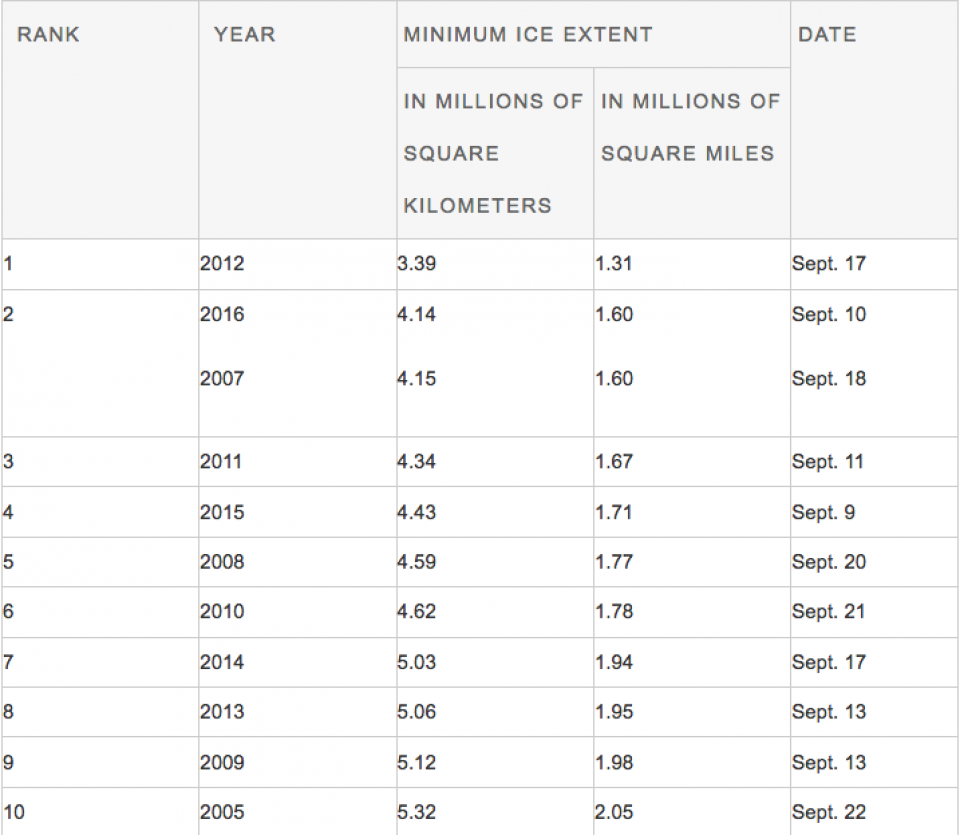
Latest news