“See Greenland before mass tourism ruins it”
iAbout Press releases
As part of our continuing efforts to bring you as much information about our region as possible we offer readers a press release service that allows private firms, public agencies, non-governmental organisations and other groups to submit relevant press releases on our website.
All press releases in this section are published in their full length and have not been edited.
If you have a press release or other announcement you would like to have published, please send it to [email protected].
We reserve the right to reject press releases we deem irrelevant or inappropriate.
All material submitted to The Arctic Journal, including pictures and videos, will be assumed to be available for publication by The Arctic Journal and its related entities.
This article is a part of The Arctic Journal’s ‘One Question’ series. In these occasional articles we pose a single question to newsmakers or regional experts about a current topic.
Previous topics include:
Rapid melting of Greenland’s ice sheet
Why John Kerry visited Greenland
Oil-spill response capacity
The conservation status of polar bears
Why the US needs more icebreakers
This article is a part of The Arctic Journal’s ‘One Question’ series. In these occasional articles we pose a single question to newsmakers or regional experts about a current topic.
As tourism continues to play an increasingly important, if divisive, role in the economies of the North, destinations are asking themselves how best they can prepare for it. In many cases, the challenge is how to deal with what appears to be a law of diminishing returns: the more people places attract, the less attractive they become to future guests.
We asked Erik Bjerregaard, the general manager of Hotel Arctic in Ilulissat, Greenland, and a recent recipient of the Trade Travel Outbound Scandinavia award, to share some of the lessons of his 25 years in the business to help us find the happy medium of Arctic tourism.
Our one question: how should Arctic territories approach tourism?
In the early days of Greenland tourism – back around 2006 – the saying in the business was “come and see Greenland before it melts”. Nowadays, we say, “come see Greenland before mass tourism ruins it”.
In Greenland, tourism authorities expect that we’re going to see gradual growth no matter what we do. My concern is what the effect on our region will be if we see a rapid growth in the number of visitors.
The other day I sent my colleagues in Visit Greenland a link to an article about how the people of Amsterdam were fed up with the number of tourists there. I asked them if this was the Greenland we were going to see in 2022?
SEE RELATED: Unknown and unaffordable
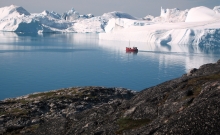
Greenland is a unique place. What people want when they come here is the vastness, the silence and the purity Greenland can offer them. I don’t believe that it’s wrong to build longer runways and do things to attract tourists, but we risk spoiling what makes us special if we attract too many.
One of our challenges is that we have a short season. We don’t have 12 months like other destinations. Between 2013 and 2016, we’ve seen a 66% growth in the number of tourists. This year is going to be our best year ever, and better than we expected, but all those people coming puts a lot of strain on the infrastructure, the environment and the experience people have here.
Case in point, a few years back there was a couple that decided they wanted to hold their wedding out at the Icefjord, here amid the natural beauty. What happened? Well, first one group of tourists, some with drones, came. Then another group came. They spoiled the whole thing for them.
That’s just one instance, but we need to make sure that people don’t come away from here feeling that way at all. One solution might be to limit the number of visitors permitted to the most popular destinations. That would allow us to make it easier to give them the experience they came for.
SEE RELATED: Keeping it authentic
The people who come here are generally well informed and respectful. That’s the sort of profile we would like to continue to attract, but even if people are good visitors, you can still have too many of them.
My opinion goes somewhat against the common wisdom, but my argument is that the Arctic is a vulnerable place and the impacts we make here are long lasting.
If you need an example, not far from here is a place called Base Camp Eqi. It is a tourist lodge now, but in the 1940s and ‘50s, the French used it as their base camp to get up on the ice cap. They tracks left behind by their vehicles are still there.
Ilulissat is Greenland’s biggest tourism destination. I believe it will stay that way until we ruin it.
Latest news